Browsed by
Tag: productivity

To Solve a Problem, Sleep on It

To Solve a Problem, Sleep on It

Sleep is a precious resource to regenerate you physically and mentally. But it’s also a natural way that helps you solve all sorts of problems. Learn how to utilize this natural process to find answers and achieve your goals. Watch To Solve a Problem, Sleep on It.

Transcript:

Welcome. I’d like to talk to you about a natural way you can use to solve all sorts of problems you might have. It’s a way that boosts your creativity and insights, and a process you experience every day. Or, at least I hope you do. That process is sleep. And I’d like to share how to use this tried and true method to deliberately solve a problem.

I’m Linda-Ann Stewart, a focus mentor, writer and hypnotherapist. These videos are dedicated to empower you to focus and align your heart with your vision so you can achieve your goals.

Research shows that a person with a problem who “sleeps on it” will be twice as likely to awaken with insights and solutions than someone who stays awake to think and worry about it. You can train yourself to find solutions by letting your subconscious mind work on the problem as you sleep.

To use this technique, before you go to sleep, think about your problem. Then, let it go, saying something like, “I’ll have the answer to it in the morning.” In the morning, before you check your phone or do anything else, write down any insights or ideas you might have. If nothing comes immediately, don’t worry, an answer may surface during the day. If it doesn’t, rinse and repeat the technique that night.

Thomas Edison said, “Never go to sleep without a request to your subconscious.” In addition to solutions to problems, you can use this process for ideas on achieving your goals, creative breakthroughs, increasing your clarity or other issues. Utilize your natural ability for inspiration and to improve your life.

Thank you for watching. If you liked this video, please give it a thumbs up. And if you’d like to be notified when I release more videos on mindset, motivation and empowerment, please like my channel and click on the bell. As always, stay focused.

Read the accompanying article, How to Master Problem Solving.

It’s Safe to Relax

It’s Safe to Relax

by Linda-Ann Stewart

As I was guiding a client into self-hypnosis using a relaxation technique, I noticed her shoulders becoming more and more tense. I suggested “It’s safe to relax,” and her shoulders dropped. She successfully went into self-hypnosis and we continued with her session. At the conclusion, she opened her eyes and said, “I couldn’t relax until you told me it was safe to do so.”

Are You Afraid to Relax?

I’ve heard this same thing from numerous clients. Many people have a fear of letting go and relaxing for a variety of reasons. Some of them have come from dysfunctional homes, and have learned to be hypervigilant in order to survive. Others have been through a long period of crises that have emotionally hit them over and over, until they, too, are hypervigilant. People with either of these issues often fear that something awful will happen if they let down their guard.

Sometimes anxieties or fears will begin to surface as a person starts the relaxation process. These are feelings that they’ve been able to keep suppressed and are now rising to the surface because their conscious control of them has loosened. Or a person could simply become apprehensive because relaxing is so unfamiliar that they feel uncomfortable doing it.

Tension Depletes You

Stress, tension or a sense of pressure signals the brain to keep the mind and body on alert, prepared for physical danger. Waiting for the other shoe to drop, or the next crisis, damages the body in subtle ways. The medical profession believes that stress causes or worsens  over 90% of illnesses. It’s like water dripping through a hole in a glass. Eventually, the glass will empty completely. Stress and tension actually wear away body systems, until they are depleted.

Being able to relax is essential to a person’s well-being, both physical and emotional. Relaxation allows the body to heal in a natural fashion, like replenishing the water in the glass. The body then has a reservoir of energy to draw from and preserve health.

Relaxation Replenishes You

Relaxation is the way we tell the brain that we’re safe, that all is well. For those who’ve existed in a dangerous environment, feeling safe is a new concept. I remind them that if there’s going to be a crisis, it’s going to happen whether they’re tense or relaxed. Relaxation not only gives the mind a feeling of safety, it provides it with more resources, reserves, and resiliency to handle the challenges of life.

Where a small setback, like being late to work, might have been all that was needed for a mental meltdown, the more relaxed person can keep the situation in perspective. Creativity and problem solving are also enhanced, as is mental flexibility. A person can be more productive and efficient, because their mental resources aren’t diverted to keeping them alert for a danger which may no longer exist. 

Relearn to Relax

In our fast-paced world, we have a habit of  being tense. Although relaxation is a natural process, it needs to be relearned. I tell my clients that they’re entering a period of training. They’re re-educating their bodies and minds to let go of tension and return to their natural state of relaxation. As they practice, they feel better mentally, emotionally, and physically. They quickly find that the rewards of relearning to relax are powerful and tangible.

Affirmation:

It’s safe to let go and relax. I’m safe now. I drop my shoulders, and release the tension in every part of my body. By relaxing, I’m allowing healing energy to fill my mind, body and spirit. In doing so, I have more resources and resiliency to deal with the challenges of my life. I trust that all is well, and Divine Right Action takes place for the Highest Good of all concerned.

As a focus mentor, hypnotherapist, and writer, Linda-Ann Stewart motivates women entrepreneurs and small business owners to focus and transform their business through deliberate actions that break through distraction and overwhelm to greater success, wellbeing and prosperity.To boost productivity and reduce overwhelm, register for her FREE guide, Design Your Best Day, at https://www.Linda-AnnStewart.com/guide.html

A Fun Way to Cultivate Happiness

A Fun Way to Cultivate Happiness

Happiness increases your success, improves your health, and raises your creativity and productivity. There are easy ways you can use to elevate your mood and pleasure, which adds to your happiness. Discover a powerful way to create happiness that you can use every day. Watch A Fun Way to Cultivate Happiness.

Transcript:

Welcome. Did you know the mind can’t tell the difference between what is real and what is imagined? This is why advertisers use strong, emotional imagery to sell their products and services. The viewer imagines themselves in that picture.

I’d like to share a tip on how you can use this process to boost your happiness. Because happiness increases your success, improves your health, raises your creativity and productivity. Who wouldn’t want that?

I’m Linda-Ann Stewart, a focus mentor and hypnotherapist. These videos are dedicated to empower people to focus and align their heart with their vision so they can achieve their goals. I’ve been helping people improve their lives for over 30 years using a variety of techniques, including guided visualization, so I know its power. But you don’t have to be in an induced trance to get drawn into imagery.

Just imagining, or remembering, laughter lifts your emotional state. What if you did that a couple  times a day? Also, when you go to a movie or watch a TV show, you’re totally engaged with the action. So, watching a comedy movie or TV show can improve your mood and raise your level of happiness.

I’m sure you’ve watched funny cat videos at some point, and that has helped to elevate your mood, right? Happiness increases productivity, so maybe employees taking a break to watch funny videos actually become more effective. As long as they watch for only short periods of time, or else the boss may object.

So just remembering the funny video will cause you to smile. Remember, the mind can’t tell the difference between what is real and what is imagined. Use that to your benefit.

The more often you feel uplifted and joyful, the more you’re building neural patterns to stay in that mental space. Use the power of imagery, whether in your own mind or as entertainment, to cultivate an attitude of pleasure and happiness.

Thank you for watching. If you’d like to be notified when I release more videos on mindset, motivation and empowerment, please like my channel and click on the bell. As always, stay focused.

Read the accompanying article, How to Improve Your Happiness Level.

As a focus mentor, hypnotherapist, and writer, Linda-Ann Stewart motivates women entrepreneurs and small business owners to focus and transform their business through deliberate actions that break through distraction and overwhelm to greater success, wellbeing and prosperity.To boost productivity and reduce overwhelm, register for her FREE guide, Design Your Best Day, at https://www.Linda-AnnStewart.com/guide.html.

How to Improve Your Happiness Level

How to Improve Your Happiness Level

by Linda-Ann Stewart

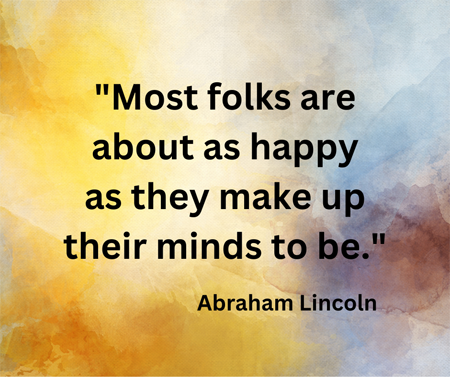
“Most folks are about as happy as they make up their minds to be.” Abraham Lincoln

Our western culture pushes the idea that achieving success will bring happiness, when the opposite is actually true. I’m sure you know people who pursue success, money and power, thinking it will bring them happiness. When it doesn’t bring lasting joy, they double down to accumulate more.

In actuality, the elation over a positive event, like a promotion or winning the lottery, is transitory. After a few months, the euphoria wears off, and the person’s level of happiness drops to what it was before the event.

Happiness could be defined as a state of wellbeing, contentment, satisfaction and fulfillment. These attributes depend on whether you have a generally positive mindset or not because happiness and optimism are closely intertwined.

The Good News about Happiness

According to some researchers, about 60% of your happiness comes from heredity and life situations beyond your control. Fear not, however. About 40% of your happiness derives from what you do in your everyday life. This means that much of your happiness is based on the choices you make. Building a well of happiness from within is under your control and more pervasive than seeking it from outside sources.

There are multiple benefits to happiness, beyond just making you feel good. Happiness affects the following and more:

Increases your success. You’re more likely to receive sales, promotions and awards.

Improves your health. Your immunity increases, heart disease decreases, and mental acuity is better as you age.

Opens up doors to greater creativity. When you’re in the flow, you have more mental resources to be inspired.

Causes you to be more productive. You have more energy and seek out more opportunities.

Enhances your relationships. You’re more open, interact better and little annoyances don’t bother you as much.

Builds a positive attitude. You look on the bright side of situations and seek out beneficial solutions.

Strengthens your ability to fulfill your potential. You tap into qualities that allow you to think better and make better decisions.

Raises your vibration. You feel lighter and clearer, therefore your vibration is higher.

Attracts more good to you. Allows you to be a clearer conduit for the Universe and the Law of Attraction.

All of these benefits are within your grasp, based on the choices you make each day. Happiness isn’t just a random occurrence, inspired by a positive experience. The thoughts you focus on develop new neurons and “neurons that fire together, wire together,” creating new connections in your brain. Through repetition of specific thoughts and actions, you can raise and strengthen your level of happiness and optimism.

How to Cultivate Happiness

By keeping your attention on something good, you cultivate new patterns of well being within yourself. And the more you do this, the more you feel good. It’s true that, in your brain, “What you focus on expands.”

Here are 6 ways to build more pathways in your brain to a sense of wellbeing, satisfaction and happiness:

Smile. Not only can a smile be contagious, it activates part of your brain to bring you more contentment. When you smile, your brain releases positive chemicals and hormones to make you feel good. Spend one minute in the morning to smile, and you’ll start the day off well.

Be kind. When you give to others, it also makes you feel good. Being kind activates parts of your brain that bring you a rush of euphoria. Just sending a card or email of appreciation to someone will brighten your day, as well as theirs.

Count Your Blessings. Gratitude stimulates the production of reward and pleasure chemicals in the brain, making you feel upbeat. Studies have found that if you list three things you’re grateful for each day, you’ll notice your happiness and attitude improve within three weeks.  

Detailed Gratitude. To deepen the impact of gratitude, each day find one thing that made you happy or grateful and write about it in detail. Spend at least a couple of minutes on this exercise. When you also visualize and savor the experience, this increases the effect and brings even greater satisfaction.

Meditate. Meditation grows the area of your brain responsible for joy. Whether it’s a consistent five minutes a day or longer, meditation will rewire your brain and your brain’s function. All you need to get started is to take long, slow deep breaths, in through your nose, and out through your mouth. Focus on your breathing. If your mind wanders (as it will), just bring it back to your breath.

Build social relationships. When you hang out with friends, this increases your ties with other people and improves your mental health. This can be done in person or virtually. I have several good friends who live a long distance from me, but we stay connected either through the phone or online.

Greater happiness can be yours using these small steps. Consistency will retrain your brain to be happier and build more neural circuits that support joy.

Affirmation:

The Universe wants the best for me. Success may not lead to happiness, but happiness leads to success. Happiness is a natural state for me, well within my grasp. I no longer wait to be happy but choose to be happy, now. What I focus on expands, and as I open myself to more happiness, more flows to me. The Universe supports me in finding simple ways to cultivate happiness in my life now.

Watch the accompanying videos, Craft a Sustainable Well of Happiness and A Fun Way to Cultivate Happiness.

As a focus mentor, hypnotherapist, and writer, Linda-Ann Stewart motivates women entrepreneurs and small business owners to focus and transform their business through deliberate actions that break through distraction and overwhelm to greater success, wellbeing and prosperity.To boost productivity and reduce overwhelm, register for her FREE guide, Design Your Best Day, at https://www.Linda-AnnStewart.com/guide.html You can contact her at LAS@Linda-AnnStewart.com or 928-600-0452.

Avoid the Paralysis of Perfection

Avoid the Paralysis of Perfection

Do you try to get everything done perfectly? That can lead to procrastination and undermine the outcome you’re seeking. Instead of trying to be perfect, use this mindset tip to complete your project and move to your next accomplishment. Watch Avoid the Paralysis of Perfection.

Transcript:

Welcome. I’m Linda-Ann Stewart and I empower people to focus and achieve their goals and vision. Today, I’d like to talk about perfectionism and how it holds you back.

I once knew an artist who was a perfectionist about her paintings. She worked on one for years. It was of dried leaves and a tree stump. You wouldn’t think that subject would be interesting, but her depiction of it  was beautiful.

For one thing, the leaves that she’d completed were amazing. You’d have sworn they were real. But she spent so much time on each leaf, meticulously trying to get it perfect, that she never finished the painting. Eventually, she moved on to work on other pieces.

Although that painting wouldn’t have been as detailed, it would have been better for her to have completed it without agonizing over every vein in every leaf. No one would have noticed them missing, and the picture still would have been phenomenal. Unfortunately, that partially completed masterpiece sat in the closet and few people ever had the joy of seeing it.

Do you avoid finishing a project, because you don’t think it’s perfect enough? Perfectionism can lead to procrastination, which can create paralysis. You dread dealing with the project, and that resistance takes energy away from it and other things. The dread hangs over your head, taking up valuable mental real estate.

My coaching tip is a mindset shift. There are motivational statements like, “Done is better than perfect,” and “Progress, not perfection.” They may be trite, but they’re true, and important to remember if you get bogged down in trying to be perfect. No one but you is going to know your project is not up to your standard of perfection. It will be perfectly acceptable to them and appreciated. 

Like my friend’s painting, it really is better to just complete what you’re working on. You’ll get so much more done. Even if the result isn’t as great as you’d like, you can then move on to your next accomplishment. Thank you for watching. If you liked this video, please like my channel so you’re notified when I post future ones. Stay focused.

Read the accompanying article, Seek Persistence, Not Perfection.

The True Role Of Your Inner Critic

The True Role Of Your Inner Critic

by Linda-Ann Stewart

Rainbow and tree

Are you constantly putting yourself down? Do you ever tell yourself demeaning statements like: “You can’t do that,” “What’s the point,” “You don’t deserve anything,” “You’re so stupid.” Do you feel guilty when you do something as innocuous as spill a glass of water or drop a cookie on the floor? If so, you have an active inner critic.

Your inner critic or judge is an aspect of your personality that echoes what the authorities in your life said to you when you were younger. My fourth grade teacher berated the class with “You’re so stupid,” until many of us believed the lie. A friend’s father convinced her that she was worthless. One of my clients was told that she was responsible for the happiness of her entire family.

Old Messages

These are all false ideas that are accepted by the person because of the authority of those who stated them. As we grow up, we internalize the concepts as our inner critic. It takes over the role of the critical people from our youth and it repeats their messages over and over. In adulthood, those we’re close to and respect can trigger the critic’s voice and add to the messages.

The inner critic holds you back, makes you doubt yourself, lowers your self-worth, and undermines your self-confidence. It judges your behavior by someone else’s standards and reaffirms that you don’t measure up to their unreasonable expectations, and makes you feel guilty for failing. My clients have said that they don’t feel like they’re “enough.” That nothing they do will be good enough, or that they can’t fulfill what they believe is expected of them.

What Your Inner Critic Is Trying to Do

Believe it or not, this aspect of your personality is actually trying to help you. It accepted the attitude from the people you were dependent on to try to protect you from their disapproval. If a child spills his milk, and cries from fear of punishment, then his mom generally will reassure him and just wipe it up. He’s accepted his responsibility, since he’s showed his remorse, so mom figures she doesn’t have to chastise him. By feeling guilty, he’s protected himself from being sent to the corner.

A child will emulate the attitudes of the caregivers around him to try to fit in. Because if he doesn’t get accepted by the clan, then he’s shunned, abandoned either physically or emotionally, and that means death to a child. Even if the child rejects the attitudes of the caregivers as unreasonable, he will still have soaked them in before he was old enough to recognize their unfairness.

So your inner critic is still trying to keep you safe. However, it’s trying to protect you from an environment that you left long ago. You no longer need the approval of your caregivers in order to survive. You have the ability to say “no” and have it stick. If you’re in an unfriendly situation, you can now leave. Even if it’s difficult, you can still leave and you will survive. You inner critic is responding to conditions that you’ve outgrown, but this part of you doesn’t realize it.

How to Work with Your Inner Critic

Instead of fighting against your inner critic, or knuckling under it, you can begin to re-educate it. Its true role is to help you, protect you, to encourage and nurture you. If it realizes that you’re a big person who’s living in a different environment, with the ability to take responsibility for yourself, it will generally begin to reduce its nagging. You can let it know that it needs to update its responses so that it actually helps you in your present day conditions.

Once it begins to understand its true role, and uses its energy to help you in the now, you’ll notice a tremendous improvement. You’ll have more self-confidence, feel better about yourself and be more productive because you won’t be second-guessing every little thing you do. You won’t be fighting against yourself anymore, and your whole inner being will be on your side.

Affirmation:

The critic within me no longer needs to protect me the way it did when I was a child. I now have the knowledge to protect myself. My inner critic now recognizes this and updates its protection so that it serves me in my current life. It now fulfills its true role to help me, encourage me, and nurture me.

Why Is Focus Important for Success?

Why Is Focus Important for Success?

Ingafay Faison Cavitt and I met at a virtual networking event. She introduced herself as a Confidence Coach for Women. Since that was one of my specialties in my hypnotherapy practice, we scheduled a video call to get to know one another better. She works with women in direct sales to become the person they were destined to be. At the end of our conversation, she decided that my approach as a focus coach would work well on her podcast.

Being able to focus is vital to being successful in business, so that’s the approach we decided to take. I shared my story of  how, when I focused on one item at a time on a long to-do list, I was finally able to complete items in a short period. Ingafay agreed that doing one thing at a time is more productive.

We discussed how getting distracted can feel rewarding, but you don’t get much done. And it can cause you to seek out more distractions. Oddly enough, one hour of focused time is equivalent to many more hours of distracted time.

I shared 4 steps that anyone can use to develop the skill of focus. One of those steps was to take breaks after a period of concentration to give the mind time to recover. Ingafay asked if a break could be like doing household chores and I said, “Yes.”

At the end of the podcast, she asked me about something I’d mentioned  when we’d had our first conversation. She asked, “Can you talk again about introverts and extroverts?” I explained that introverts and extroverts need different types of stimulation to focus for productivity. Extroverts work best around other people and introverts work best alone. I shared how a friend had tried me to work her way, and I couldn’t. I really enjoyed talking with Ingafay and wished we had more time. We both have the mission to lift women up, support and empower them to have better lives. Women have the power to fulfill their dreams.

~ Linda-Ann Stewart

How One Small Technique Can Improve Your Attitude

How One Small Technique Can Improve Your Attitude

by Linda-Ann Stewart

When you’re in a bad mood or feeling down, it seems like nothing goes right. If you can shift your attitude to being more upbeat, life flows more smoothly. There is a simple technique you can use to improve your mood and attitude, and it just takes a minute. Here are 3 tips on how to use it to feel better and be happier.

Transcript:

Thank you for watching. I’m Linda-Ann Stewart, a vision empowerment coach. Everyone has bad days, right? When you’re having one, it’s hard to get anything done, isn’t it? You feel like you’re wading through molasses. You know you’re fighting an uphill battle with your attitude and it seems that anything that could go wrong, does go wrong.

You realize that if you can shift your mood to a better one, everything flows more smoothly, right? What if I told you there was one small action you could take that could boost your attitude, lower your stress, and be happier? Would you try it? I certainly would.

Believe it or not, it’s something as simple as smiling. Please, bear with me. I know, when you’re feeling down, the last thing you want to do is smile. But smiling, whether you mean it or not, will make you feel better. It stimulates your brain into a more positive state, fooling it into thinking that you are actually feeling good. The old cliché, “Fake it until you make it,” is true in this situation. The brain can’t tell if your smile is real or forced. 

My first tip is going to look silly, but try it. You have nothing to lose, except your dignity. When you’re not feeling like smiling, but want to feel better, take a pen or pencil and put it between your teeth. [DEMO]

Looks silly, right? But notice how it activates the same muscles you use when you’re smiling? The muscles of the corner of your mouth turn up. Your brain doesn’t know that you’re just pretending. Hold it for a minute or so, and then take it out. Try smiling on your own, and see if it isn’t easier. 

My second tip is to start the day by deliberately smiling for 30 seconds to a minute. That will set your day up to be more productive, and you’ll approach your work with a more positive attitude. When you’re more positive, your day goes smoother, doesn’t it?

My third tip is to do the same thing when you hit a slump or start to feel stressed during the day. Smile for 30 seconds to a minute, again. It will cause you to be more upbeat, lower your stress and energize you.

So, “Turn that frown upside down.” Yes, I know, it’s corny. But smiling will encourage your brain to shift into a more positive state. You’ll look at your life differently. And when you change your attitude, then your responses, and your life, changes.

Please subscribe to my YouTube channel to receive more mindset coaching tips to improve your life.

Thank you for watching. And remember, smile.

Please read the accompanying article, How Simple Actions Improve Your Attitude.

~ Linda-Ann Stewart

Focus, the Power Behind Success

Focus, the Power Behind Success

by Linda-Ann Stewart

"Your ability to focus is the most important success skill you can ever develop." Brian Tracy

“Your ability to focus is the most important success skill you can ever develop.” Brian Tracy

In today’s world, it’s hard to stay focused. It seems that every minute, there’s something to divert your attention. You probably check your email several times a day. Every time there’s a notification from your phone, you have to see what it is. That’s in addition to interruptions from co-workers, family and friends. After a distraction, studies show it takes at least fifteen to twenty minutes to get focused again.

Also, your mind can focus on only one thing at a time. Each time you shift your attention from one thing to another, you’re “task switching” and it burns up extra mental energy. When the entire day is filled with these intrusions, you end the day feeling drained and exhausted, with very little to show for it.

Benefits of Focus

However, when you’re more focused, you feel more in charge of your world, get in the flow and get more done. You also have less stress and overwhelm, because your mind has one thing to do at a time. In addition, you have more clarity, so you make better decisions, as well as being more efficient, effective, and productive.  

Therefore, to achieve your goals and dreams, your ability to focus is vital. Fortunately, it’s a skill that you can cultivate and develop. The more you focus, the more you’re able to focus. It’s just like a muscle. The more you use it, the stronger it becomes.

How to Create the Habit of Focus

You can’t be focused all the time, because the unexpected does happen on occasion. But you can set aside time each day to pay attention to your most important tasks. Schedule time into your day to focus on important projects. Here are some ways you can get started and cultivate your ability to focus.

Motivate yourself to focus. Decide how having increased focus benefits you, and remind yourself of that incentive when you set aside time for it. As you build your motivation, and act on it, focusing becomes a habit. Jim Rohn said, “Motivation is what gets you started. Habit is what keeps you going.” Once you establish the habit of focusing, your mind will automatically know what to do when you want to do it.

Use visualization. Choose one task that will move you towards your vision or goal. What is it you want to focus on and achieve in this period? Before you get to work on it, take a couple of minutes to visualize yourself performing your task and accomplishing what you want. This increases your motivation, and primes your subconscious to start solving any issues you might encounter. You’re rehearsing your actions, which then makes them easier to execute.

Eliminate distractions. Find a way to minimize the effects of whatever can intrude on your focus time. For instance, research shows that if your phone is in the same room as you’re in, your mind is always tuned to it. Even turning your phone off doesn’t work. Therefore, put your phone in another room, where you can’t see it or hear it. Turn off your email. Close your door.

Minimize multi-tasking. Constant multi-tasking trains your mind to hinder your focus. However, you don’t have to completely avoid multi-tasking. When you’re performing automatic behaviors, such as doing dishes, watching television doesn’t drain you. Or you can pay bills and listen to a podcast. But when you do activities that need you to think, multi-tasking uses up mental bandwidth and exhausts your energy. Your mind is always seeking something new, and when you multi-task, you jump from one attention getting novelty to another. Multi-tasking triggers the reward centers of the brain, therefore gives you an incentive to repeat the process, which makes multi-tasking addictive.

Strengthen your focus muscle. Set aside time to focus on one task without distractions. Start off with as much time as you can before you need a break. You may need to begin with only ten or fifteen minutes. Each week, increase the time. Aim to have a sixty to ninety-minute stretch of focusing on one topic or chore before you take a break. When you take your break, do something that rests your mind for several minutes, such as going for a walk, getting a drink, or something to eat. This gives your mind time to replenish its energy and get ready for your next work period.

Being able to focus is an inherent talent that we all have. But it’s not an skill that is exercised much, so most people have gotten out of practice with it. With the above tactics, you can cultivate your natural ability, strengthen it, and develop it into a habit that will support your success.

Affirmation:
I have a natural ability to focus and pay attention to what’s important to me. It’s a skill that I can develop and grow through practice. The Universe flows Its energy through my focus, supporting my endeavors and smoothing my path to maximize success.

Watch the accompanying video, Guided Meditation to Focus and Accomplish More.

[suffusion-the-author display=’description’]