Browsed by
Tag: empowerment

Overcome the Law of Reversed Effort, Part 1

Overcome the Law of Reversed Effort, Part 1

by Linda-Ann Stewart

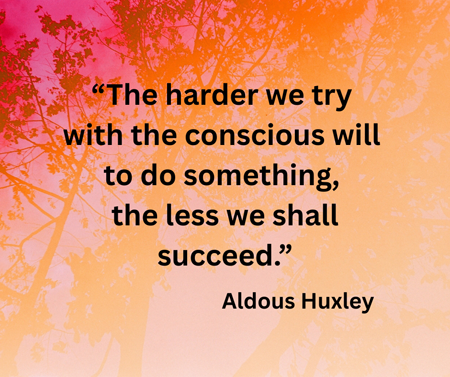
“The harder we try with the conscious will to do something, the less we shall succeed.” Aldous Huxley

“The harder we try with the conscious will to do something, the less we shall succeed.” Aldous Huxley

Have you ever tried to force yourself to go to sleep? What about willing yourself to relax or meditate? Usually, the harder you try to do any of these the opposite happened. The more tense or more awake you got. This is called “The Law of Reversed Effort,” popularized by Aldous Huxley, or “The Law of Reverse Effect,” first described by Emile Coue.  

Willpower Alone Can Sabotage You

Whenever you try to compel yourself to do some action, you create stress, tension and anxiety. Tension shuts down your creative flow, and the flow of the Universe. Stress sabotages your automatic mental and muscle memory, much like an athlete who thinks too hard about their next move. Stress blocks your progress.

Have you ever tried to change a habit with sheer willpower? It’s like trying to hold water in your fist. There’s no room for the water in your fist, and it slips away. Putting more energy into pressuring yourself to do something stirs up resistance to accomplishing it. And the more effort you put into trying to push through, the more resistance there is.

As a result, you start to think negatively, which just makes things worse, and more difficult. It doesn’t matter if it’s trying to balance your checkbook, complete a project, or change a habit. The more you try to force an outcome, the less success you’ll have.  

How to Make Progress

Instead, you have to lighten up. Open up and relax your fist, and use it as a cup to gather water. Take a step back, and let your subconscious work on a better way of achieving your next step. Often, when I’ve hit a snag with a creative venture, like writing or weaving, I take a break. When I come back to it, the answer is there or the activity flows more smoothly. For instance, to go to sleep you have to allow drowsiness to creep through you.

Other ways to make progress are to take small steps. This results in small successes, which triggers your reward center, and gains the attention of your subconscious mind. You could also focus more on your process, the steps you’re taking, rather than your ultimate goal or vision. This reduces some of the pressure, and is a valuable technique when you’re struggling to get something done.

Next month, you’ll learn about why the Law of Reverse Effect functions the way it does and one powerful way to overcome it.

Affirmation:

Instead of trying to force things to happen, I step back and allow them to take place. I now let go of all stress and tension. I open up to new ways and new ideas of doing things. By doing so, I allow the Universal flow of good to expand in my life. I’m guided by the Divine life within me to make the decisions and take the actions that benefit me the most.

As a focus mentor, hypnotherapist, and writer, Linda-Ann Stewart motivates women entrepreneurs and small business owners to focus and transform their business through deliberate actions that break through distraction and overwhelm to greater success, wellbeing and prosperity.To boost productivity and reduce overwhelm, register for her FREE guide, Design Your Best Day, at https://www.Linda-AnnStewart.com/guide.html

Rewrite the Stories Holding You Back

Rewrite the Stories Holding You Back

As children, we often believe false ideas about ourselves that adults told us. These ideas become beliefs, and we act on them as if they were true, even though they weren’t. You can begin to rewrite those old stories, using the simple exercise in this video. Watch Rewrite the Stories Holding You Back.

Transcript:

Thank you for joining me for mindset tips.

Did you know that, as children, we believe stories about ourselves, and then act on them as if they’re true? A budding artist gets told by a teacher that she has no talent, so she abandons her passion. An elementary school teacher can’t explain math, then blames her students for being dumb when they don’t understand. In the years following, the students under perform in that subject. A frustrated parent lashes out and tells a child that they’ll never amount to anything. And the child grows up to sabotage themselves just before they’re about to succeed.

All of these opinions are demonstrably false, but the children who received them accepted the ideas were true. Then those children grew up acting on the lies, and those falsehoods became self-fulfilling prophecies. Do you carry any such stories that you believed that then became true for you?

Judgements that you’ve accepted about yourself were programmed into you earlier in life. Just because you believe them doesn’t make them accurate. I’d like to share a short, mindset exercise to help you begin to erase those lies and rewrite your story about yourself.

I’m Linda-Ann Stewart, a focus mentor, writer and hypnotherapist. These videos are dedicated to empower you to focus and align your heart with your vision so you can achieve your goals.

Here’s the exercise. Divide a piece of paper into two columns. In the first column, write down something you’ve been believing, some judgement, some idea from childhood that’s been holding you back. Something like, “I’m not good enough.”

Beside it, in the second column, write, “That’s a lie” or “That’s a falsehood” or any other phrase that denies its validity.

Below, in the first column again, write the opposite of that false belief, such as, “I am enough.” Include comments from friends, co-workers, or even superiors that support your new idea about yourself.

Include any objective measurement that confirms this new belief. Then, in the second column, write, “This is the truth,” or “This is the fact,” or anything else that confirms it for you.

It may take some time, but this exercise will help you deconstruct childhood programming, and recognize and accept what is true about you. Keep repeating the new idea to yourself. As you do, you’ll begin acting on your new belief, which will change the course of your life for the better.

Thank you for watching. If you liked this video, please give it a thumbs up. And if you’d like to be notified when I release more videos on mindset, motivation and empowerment, please like my channel and click on the bell. As always, stay focused.

Read the accompanying article, What Stories Are You Telling Yourself That Are Holding You Back?

What False Ideas Do You Believe?”

What False Ideas Do You Believe?”

by Linda-Ann Stewart

Thoughts

A client came to me with very low self-esteem. In our consultation, she stated that her parents had told her that she was “worthless,” she’d “never amount to anything,” and they “wished she’d never been born.” She wondered why she’d sabotaged her professional career, tried to avoid attention that could further her career, and had trouble with relationships. The trouble was that her subconscious had accepted her parents’ edicts as fact, and was following its programming.

No matter what she tried to accomplish, her subconscious was acting on false information about her as if it were true. It viewed everything about her through the incorrect lens of those ideas. If she began to succeed, it said, “No, you can’t. If you do, you’ll violate the beliefs of worthlessness that your parents taught you.”

When she tried to assert herself, her subconscious held her back with fear, because she’d disagree with what she’d been told about herself. She attracted friends and lovers who echoed her parents’ ideas, putting her down and belittling her. All of this was her subconscious mind manifesting her belief, or lack thereof, of her self-worth, and making sure that she stayed within the boundaries of its information.

Ideas Your Subconscious Mind Accepts

The subconscious mind will act on an inaccurate concept as if it were true. If you’ve accepted an idea that you can’t lose weight (stop smoking, make money, succeed, can’t paint or anything else), then your subconscious will make sure that the belief gets justified. These may be attitudes that were handed to you by parents, teachers, friends, family, or society and because of the emotional impact, you soaked them up like a sponge. From then on, the subconscious will view everything in your life through these attitudes and make sure that they’re confirmed. It’ll attract situations that will verify your beliefs.

Even if there’s an experience that could change your mind, because of the programming, your subconscious will only accept the information that would validate your preconceived notions. For example, Jo might receive a compliment from the boss on her work. But because she doesn’t believe she’s that capable, she’ll ignore it, telling herself that the boss just said that to make her feel good.

Your Beliefs Can Change

The good news is that these false concepts can be changed. It takes persistence and consistency, but by using affirmations or self-hypnosis, you can change the incorrect facts. The first step is to recognize what erroneous ideas you’re acting on in the present.  Where are they holding you back? Without identifying the problem, you can’t move to the solution.

Examine the thoughts that come into your mind when you’re about to succeed at whatever goal you have. If they’re negative thoughts about you or your goal, those are the incorrect assumptions you’ve been acting on. Then create a positive statement that counters the negative one. This is your affirmation that you use whenever you think of your goal. You can also use it in self-hypnosis when your subconscious is more receptive.

My client and I worked to improve her self-esteem, convincing her subconscious that her parents were incorrect in their assessment of her. They’d done the best they could with their background, but that they were wrong when they’d said those things to her. She began to do things that were more self-affirming, and soon had a promotion at work. It took some time, because the programming had been there a long while, but soon she attracted new friends who appreciated her. And as her opinion of herself improved, so did her entire life.

Affirmation:

Any thoughts that have restricted my good are false ideas that my subconscious has accepted. They are counter to what the Universe wants for me. I accepted those false concepts before I knew any better. My subconscious mind knows that I no longer need or want them. I release them and now create new ideas that are more in alignment with the good that the Universe holds for me.

As a focus mentor, hypnotherapist, and writer, Linda-Ann Stewart motivates women entrepreneurs and small business owners to focus and transform their business through deliberate actions that break through distraction and overwhelm to greater success, wellbeing and prosperity.To boost productivity and reduce overwhelm, register for her FREE guide, Design Your Best Day, at https://www.Linda-AnnStewart.com/guide.html

What Stories Are You Telling Yourself That Are Holding You Back?

What Stories Are You Telling Yourself That Are Holding You Back?

by Linda-Ann Stewart

When Tammy was very young, her mother had a good friend with several children Tammy’s age and younger. When the lady would come to visit, her brood would come with her. They’d bully Tammy, play with her toys, destroy them and steal from her. When Tammy objected, the lady said that she had no right to complain, because Tammy had advantages that her children didn’t have.

This idea was reinforced several times during Tammy’s childhood. If Tammy excelled, there was often a teacher or adult who told her that she was making others, who hadn’t done as well, feel bad. As a result, the story she told herself was that if she made herself small and invisible, others would feel better.

Did it work? No. They never felt better. Tammy has worked her entire life to overcome the story that her achievements harmed others. That story derailed her in many areas of her life.

What Are Your False Stories?

Unfortunately, many times, opinions that we received from adults when we’re kids build into self-sabotaging beliefs. What false stories are you telling yourself that are holding you back? They may be ideas that an adult or friend told you when you were a child.

The ideas may not have been malicious, but simply to deal with an unfortunate or uncomfortable situation for them. And although you were never meant to take those ideas to heart, they might have impressed you deeply. Then, you created a whole false impression about yourself based on them.

Think about some of the beliefs you hold about yourself and your world that have been undermining you. Ask yourself:

  • “Where does that belief come from?”
  • “What was the intention of the person who gave it to me?”
  • “Is it actually true?”
  • “Does that belief serve a purpose now?” 
  • “If so, what?”
  • “What can I do to change it?”

Update Your Stories

When Tammy finally realized how those adults had impacted her, one way she began to dismantle the story was to ask herself, “What kind of adult says those things to a child?” That helped her realize that the adults were being unreasonable and cruel to her. The adults were trying to protect their kids, or other children, at her expense.

When you’re able to realize your self-sabotaging beliefs were often based on someone else’s frustration,  inadequacy, or convenience, you can begin to deconstruct them. They don’t benefit you now, or reflect who you are. It’s time to dispose of them, and begin creating stories that reflect who you truly are. Develop beliefs and stories about yourself based on reality, your strengths, values and abilities, and that support your goals and aspirations.

Affirmation:

I deserve to be myself. I give myself permission let go of old, false and outdated ideas that I once accepted about myself. They never reflected who I was. The Universe loves and approves of me as I am. I now accept myself, right here and right now, knowing that who I am is enough. It is safe for me to be true to myself.

As a focus mentor, hypnotherapist, and writer, Linda-Ann Stewart motivates women entrepreneurs and small business owners to focus and transform their business through deliberate actions that break through distraction and overwhelm to greater success, wellbeing and prosperity.To boost productivity and reduce overwhelm, register for her FREE guide, Design Your Best Day, at https://www.Linda-AnnStewart.com/guide.html

Break the Habit of Complaining

Break the Habit of Complaining

Did you know that the average person, in general, complains 15-30 times, or about 8 minutes, a day? Unfortunately, it’s all too easy to fall into a habit of complaining without even realizing it. And it can be a difficult habit to break. Discover a mindfulness tip that can help you, and shift your mindset to be more positive. Watch Break the Habit of Complaining.

Transcript:

Welcome to mindset tips.

Did you know that the average person, in general, complains 15-30 times, or about 8 minutes, a day? From what I hear around me, I’d bet it’s a lot more than that. Unfortunately, it’s all too easy to fall into a habit of complaining without even realizing it. Have you ever noticed that? And it can be a difficult habit to break. I’d like to share a mindfulness tip that can help you break the habit, and shift your mindset to be more positive.

I’m Linda-Ann Stewart, a focus mentor, writer and hypnotherapist. These videos are dedicated to empower you to focus and align your heart with your vision so you can achieve your goals.

This is a tip that has been used for decades, in one way or another, and it’s very simple. Mainly, it’s to make you aware of when you complain, which means you can then decide whether you want to continue or not. When a habit is brought out of the shadows and into the light, it can be changed. This empowers you and shifts your attention from being negative, to giving you the choice of being more positive.

The technique is to get a rubber band or bracelet and wear it every day. Any kind of bracelet, [Bands, elastic, sparkly, fabric, stones]…. Then, every time you complain, you switch the band or bracelet to the other wrist. No, you don’t snap it. … Just switch it from one wrist to the other. This allows you to turn the page….With practice, it can automatically create a mind shift to a more positive thought process.

You’re bringing the habit out of an unconscious behavior into being aware of it. You may discover that many of the things you grumble about are trivial, and you’re letting them pull you down. Some things may be out of your control, and complaining doesn’t help. Either way, the point is to notice when you’re complaining, and what about, and choose what to do from that point.

Since complaining compounds stress and stifles creativity, you may decide to simply refrain from contributing to the negativity. Shift your attention to what you can control and what you can do about the situation. This is more productive and will bring you greater rewards mentally, physically and in your personal and professional life.

If you’d like to break the habit, find a band or bracelet and start practicing.

Thank you for watching. If you liked this video, please give it a thumbs up. And if you’d like to be notified when I release more videos on mindset, motivation and empowerment, please like my channel and click on the bell. As always, stay focused.

Read the accompanying article,  Complaining Trains You to Be Negative, Part 2.

Focusing Beyond The Problem

Focusing Beyond The Problem

by Linda-Ann Stewart

There’s a secret to a martial artist breaking a board, brick or any other solid object with his hand (or foot or head). He aims his force, not on the target, but a foot beyond it. If he focused his energy on the surface of the board, the object would abruptly and painfully stop his hand. Instead, he imagines his hand going through the wood to the space behind it, where he wants the energy to dissipate.

The same thing is true when we have a problem we’re trying to solve or eliminate from our lives. If we focus on the challenge, we’re concentrating on the surface issue, and our subconscious simply creates more of it. The solution can’t appear as long as the condition fills our consciousness. When we affirm about a solution appearing, but feel frustrated, upset or concerned about the situation, or think about the problem in any way, then our belief in the challenge stops any resolution from manifesting. Just like the board stopping the martial artist’s hand. We’re focused on the surface and not seeing through it to the possibility of a solution.

There’s Always an Answer

In every problem, there is always an answer available. When we’re affirming things to change, however, we may be trying to control how the situation resolves. We may not like the remedy the Universe has for us. Instead of a troublesome coworker changing their attitude, we may have to change jobs. Or we may have to alter our attitude to be more tolerant. Other priorities may make what we believe to be our answer obsolete. We may want more abundance, and try to increase our income at our present job, only to find that we’re unexpectedly moving to another location.

If we’re still stuck in the problem, one of the best ways to get a way to appear is to do what Emmet Fox called “The Golden Key.” Remember that God, and all Its goodness, is always at the center of every situation, no matter how negative. Turn the attention from the problem to the Universe and all of Its qualities. Meditate on and affirm harmony, abundance, joy, health, etc. in all areas of life. Remember that God is everywhere present, knowing and seeing all, has infinite power and authority, is perfect action and divine order.

Change Your Perspective

These are the ideas we want to fill our minds with when we feel blocked. In so doing, we’re getting our limited perception of the situation out of the way. We’re taking our attention from the problem to the perspective of the Universe, where the difficulty doesn’t exist. This begins to uplift our consciousness to allow more creative solutions to flow.

Frederick Bailes says in “Hidden Power for Human Problems” that we “…need to be well schooled in the art of looking through the frightening condition rather than at it.” Just like the martial artist aims his energy beyond the board, we need to focus our attention past the problem to the potential of a solution. Only in this way will we be able to break through our blocks and challenges and experience a greater and better life.

Affirmation:

I am one with the Universal Spirit, which is God. All the good of God flows in and through me and my affairs. I know that there is a perfect answer for my situation. God and all Its goodness is everywhere present, including the center of the challenge. I am open to whatever solution is for my Highest and Best good, no matter what changes it might require.

As a focus mentor, hypnotherapist, and writer, Linda-Ann Stewart motivates women entrepreneurs and small business owners to focus and transform their business through deliberate actions that break through distraction and overwhelm to greater success, wellbeing and prosperity.To boost productivity and reduce overwhelm, register for her FREE guide, Design Your Best Day, at https://www.Linda-AnnStewart.com/guide.html

How to Undo a Complaining Mindset

How to Undo a Complaining Mindset

Did you know that complaining could train you to be more negative? Learn a simple technique that can restructure your brain so you’re more positive, which increases your well being and resilience. Watch How to Undo a Complaining Mindset.

Transcript:

Welcome. Thank you for joining me. Did you know that complaining could train you to be more negative? And that the more you complain, the more you find to complain about? Unfortunately, pessimism and complaining don’t lead to a healthy and happy life, right?  

What if you could learn a tip to turn that complaining tendency around so that you were more positive? Well, that tip is what I want to share with you today.

I’m Linda-Ann Stewart, a focus mentor, writer and hypnotherapist. These videos are dedicated to empower you to focus and align your heart with your vision so you can achieve your goals.

The tip to help you undo your complaining mindset and train yourself to be more positive is probably one you’ve heard before. Gratitude. Just practicing gratitude for 8 weeks can actually rewire your brain to be more positive.

The practice is to write down 3 specific things you’re grateful for each evening for 2 months. Not general, … specific things. Instead of “I’m grateful I went for a hike,” be specific with, “I felt renewed and refreshed by being in nature, feeling the breeze, hearing the birds, and enjoying the trees, rocks and flowers.” This brings the pleasant memory into sharp focus for you to remember.  

As you practice gratitude, your brain changes its structure and the way you process experiences, and also improves your memory. You begin to notice more positive elements in your life. This increases your happiness, resilience and well being, and creates the tendency to be more positive. 

Can you commit to practicing gratitude for the next 8 weeks to improve your attitude and well being? If so, what are you grateful for today?

Thank you for watching. If you liked this video, please give it a thumbs up. And if you’d like to be notified when I release more videos on mindset, motivation and empowerment, please like my channel and click on the bell. As always, stay focused.

Read the accompanying article, Complaining Trains You to Be Negative, Part 1.

Complaining: The Good, Bad, and the Ugly

Complaining: The Good, Bad, and the Ugly

by Linda-Ann Stewart

Thoughts

In January, Cookie was vacationing in Miami Beach. She sat on a bench while she waited for her daughter to complete a purchase. A couple of well-dressed elderly ladies with shopping bags sat beside her. They began complaining about the weather (which was lovely), the crowds (light), the prices (everything was on sale), and so forth. Cookie was put off by their negativity until they swiveled and flashed big smiles at her. She realized that they’d simply been playing a social game with each other to connect.

Complaining: The Good

Complaining has a long history and can have some benefits. For instance, taking a break at the water cooler and bemoaning the new regulations can be validating. It lets you know that everyone’s in the same boat and creates camaraderie. When Sally grumbles about how much work she has, it’s a way of getting attention. She does this to let people know that she’s overwhelmed or to get appreciation.

Or Jacquie grouses to her best friend about her husband’s untidy work bench, knowing that he won’t change it. But venting about it to someone she trusts saves conflict in her marriage. Jeff complained that the photographic printer paper he ordered was wrinkled. The vendor sent him a coupon that was worth more than the paper.

Social interaction, connection, acknowledgement, release, finding solutions are beneficial uses of complaining. They are time or situation limited and serve a purpose. Also, there’s a difference between complaining, identifying a problem and observation. Noticing that a light has burned out and asking it to be replaced isn’t a complaint. Or saying that it’s raining and you got wet walking in from your car is simply a statement of fact.

Complaining: The Bad

However, when complaining descends to a gripe-fest, then it can become counterproductive. Even a positive person can get sucked into one of these. For example, Josie attended a luncheon, and everyone started finding fault about something in their lives. It began innocently, with one grumbling about her mother-in-law, another about her own mother, and then it snowballed into a competition.

Each person tried to upstage the other in how bad things were in their lives. No one won and everyone felt dissatisfied with their lives when it was over. They didn’t want to repeat the experience so avoided the next lunch. This is when complaining starts becoming destructive. Most people are repelled by this kind of negativity. It feeds into a sense of helplessness and victimhood and serves no purpose.

It also triggers the stress response. The mind perceives the situation as a threat and signals the body to prepare for danger. The body then wastes energy braced for a problem that doesn’t exist. Not only is this unhealthy, but it shuts off the mind’s ability to find any solutions. Creativity, innovation and resourcefulness close down as the mind just tries to make sure the body survives.

Complaining: The Ugly

And then there’s Carrie, who’s a serial complainer. This is the most toxic kind of complaining. She calls a friend to whine about everything from the weather to how her mother told her to get a job. When she runs out of grievances, she starts over and goes through her litany four more times before she hangs up. She rejects any suggested solutions, and refuses to shift her attention to something else. Her friend feels like she’s been run over by a truck by the time the call ends. Carrie is firmly entrenched in her victimhood and doesn’t want to give it up.

Even if you aren’t a habitual complainer, like Carrie, you may gripe more than is best for you. When you focus on the problem, you won’t be able to access your ability to find a solution. All you’re doing is reinforcing the problem, and perpetuating it. Einstein said, “We can’t solve problems by using the same kind of thinking we used when we created them.” You’ll have to shift your attention to be open to solutions before you’ll find them.

How to Change Your Attitude

Learn to identify what kind of complaining you’re indulging in, the good, bad or ugly. Become aware of what your purpose is for complaining. Do you want to connect with others, gain acknowledgement, find a solution, or something else? Is the result going to be empowering and constructive? If so, decide how you can best grumble and then move on.

However, if you just want to grouse because you’re dissatisfied with your life, it won’t bring you anything better. You’ll dig yourself a deeper hole and find more to carp about. In this case, it would be a better choice to refrain from complaining. Constructive complaining, or avoiding it completely, is more likely to get you what you want and offer more options to make positive changes in your life.

Affirmation:

Complaining focuses on the negative. When it can help remedy a situation, it can be constructive. I now become conscious of when I complain, and recognize my intention in doing so. When it isn’t constructive, I choose to let it go and focus on the positive. This is more empowering for me.  

Watch the accompanying video, Take a Break from Complaining.

As a focus mentor, hypnotherapist, and writer, Linda-Ann Stewart motivates women entrepreneurs and small business owners to focus and transform their business through deliberate actions that break through distraction and overwhelm to greater success, wellbeing and prosperity.To boost productivity and reduce overwhelm, register for her FREE guide, Design Your Best Day, at https://www.Linda-AnnStewart.com/guide.html

Getting in the Flow

Getting in the Flow

You have a powerful tool to create a better day for yourself. It will allow you to direct your energy towards your goals, and be able to enjoy better results. Learn about how this tip empowers you and builds confidence. Watch Getting in the Flow.

Transcript:

Welcome. I’d like to share a quick mindset tip for creating a better day for yourself. Wouldn’t that be great?

I’m Linda-Ann Stewart, a focus mentor, writer and hypnotherapist. These videos are dedicated to empower you to focus and align your heart with your vision so you can achieve your goals.

Here’s the tip. At the beginning of your day, focus on the best outcome you can imagine. Imagine it in detail, that everything goes your way. I know it sounds simple, right? But this tactic is very effective.

Imagining things going smoothly doesn’t mean you can’t create contingency plans. In Psycho-Cybernetics, Maxwell Maltz says to be aware of the possible problems so you can avoid them. He uses the example of a golfer. That golfer needs to know where the traps and obstacles are, but he doesn’t focus on them. His attention is on his ball and where he wants it to go.

Putting your energy towards bringing about the best outcome reduces your stress, and gives you more resources and creativity to handle any challenges. You act from a place of power and confidence, instead of fear. This means you have a much better chance of enjoying the results you want.

So focus, imagine and expect the best, and keep your eyes on the ball. 

Thank you for watching. If you liked this video, please give it a thumbs up. And if you’d like to be notified when I release more videos on mindset, motivation and empowerment, please like my channel and click on the bell. As always, stay focused.

Get Focused and into the State of Flow, Part 2

Get Focused and into the State of Flow, Part 2

by Linda-Ann Stewart

In part 1, we examined what the state of flow is and how it’s beneficial to your life. The more often you enter the flow state, the more you train your brain to enter it at will. This means that you’ll be able to induce it when you need to work on a project, or complete a task. It also means that your days will have less stress, even if there are setbacks. The Universe has more access to guide and inspire you.

Here are 9 ways to build focus and train yourself to get into the state of flow:

  1. Crafting or hobbies. Knitting, jewelry making, woodworking, or any craft or hobby will allow you to slip into the state of flow.
  2. Meditation. This practice strengthens the ability to focus, and promotes a sense of calm.  
  3. Affirmations or self-talk. By giving yourself positive reinforcement, you’re able to reduce anxiety and promote motivation.
  4. Relaxation practice. When you relax your body, your mind lets go as well, which allows it to enter the state of flow.
  5. Visualization. Imagining each part of your day going smoothly gives your subconscious mind the direction to begin to work out solutions to problems ahead of time.
  6. Mindfulness. Objectively paying attention to your breathing, scanning your body, being aware of your thoughts and emotions, and not judging them, helps you to be in the moment.
  7. Music. Listening to music, without words, engages the part of your mind that opens to flow.
  8. Reading. Just 10 minutes of reading can lower your heart rate, stress and boost relaxation.
  9. Exercise. A work out, even just walking, releases brain chemicals that counter depression and boosts mood.

Focus, and the state of flow, changes the brain, creating new pathways that improve your attitude and resilience. The more at ease and peaceful you are, the easier it is for you to handle bumps in life. As you enjoy the state of flow more, your life can also flow more smoothly. You’ll be more in tune with Universal Good. Just as water flows around obstacles and rocks, so will you.

Affirmation:

I dedicate myself to practicing the state of flow. Each time I slip into the state of focused awareness, I’m training myself to repeat it whenever I want. When I experience this state more often, my life flows more smoothly. I have all that I need to successfully handle any situation or circumstance that arises. I am more easily guided and directed by Universal Mind.

As a focus mentor, hypnotherapist, and writer, Linda-Ann Stewart motivates women entrepreneurs and small business owners to focus and transform their business through deliberate actions that break through distraction and overwhelm to greater success, wellbeing and prosperity.To boost productivity and reduce overwhelm, register for her FREE guide, Design Your Best Day, at https://www.Linda-AnnStewart.com/guide.html