Browsed by
Tag: attitude

Complaining: The Good, Bad, and the Ugly

Complaining: The Good, Bad, and the Ugly

by Linda-Ann Stewart

Thoughts

In January, Cookie was vacationing in Miami Beach. She sat on a bench while she waited for her daughter to complete a purchase. A couple of well-dressed elderly ladies with shopping bags sat beside her. They began complaining about the weather (which was lovely), the crowds (light), the prices (everything was on sale), and so forth. Cookie was put off by their negativity until they swiveled and flashed big smiles at her. She realized that they’d simply been playing a social game with each other to connect.

Complaining: The Good

Complaining has a long history and can have some benefits. For instance, taking a break at the water cooler and bemoaning the new regulations can be validating. It lets you know that everyone’s in the same boat and creates camaraderie. When Sally grumbles about how much work she has, it’s a way of getting attention. She does this to let people know that she’s overwhelmed or to get appreciation.

Or Jacquie grouses to her best friend about her husband’s untidy work bench, knowing that he won’t change it. But venting about it to someone she trusts saves conflict in her marriage. Jeff complained that the photographic printer paper he ordered was wrinkled. The vendor sent him a coupon that was worth more than the paper.

Social interaction, connection, acknowledgement, release, finding solutions are beneficial uses of complaining. They are time or situation limited and serve a purpose. Also, there’s a difference between complaining, identifying a problem and observation. Noticing that a light has burned out and asking it to be replaced isn’t a complaint. Or saying that it’s raining and you got wet walking in from your car is simply a statement of fact.

Complaining: The Bad

However, when complaining descends to a gripe-fest, then it can become counterproductive. Even a positive person can get sucked into one of these. For example, Josie attended a luncheon, and everyone started finding fault about something in their lives. It began innocently, with one grumbling about her mother-in-law, another about her own mother, and then it snowballed into a competition.

Each person tried to upstage the other in how bad things were in their lives. No one won and everyone felt dissatisfied with their lives when it was over. They didn’t want to repeat the experience so avoided the next lunch. This is when complaining starts becoming destructive. Most people are repelled by this kind of negativity. It feeds into a sense of helplessness and victimhood and serves no purpose.

It also triggers the stress response. The mind perceives the situation as a threat and signals the body to prepare for danger. The body then wastes energy braced for a problem that doesn’t exist. Not only is this unhealthy, but it shuts off the mind’s ability to find any solutions. Creativity, innovation and resourcefulness close down as the mind just tries to make sure the body survives.

Complaining: The Ugly

And then there’s Carrie, who’s a serial complainer. This is the most toxic kind of complaining. She calls a friend to whine about everything from the weather to how her mother told her to get a job. When she runs out of grievances, she starts over and goes through her litany four more times before she hangs up. She rejects any suggested solutions, and refuses to shift her attention to something else. Her friend feels like she’s been run over by a truck by the time the call ends. Carrie is firmly entrenched in her victimhood and doesn’t want to give it up.

Even if you aren’t a habitual complainer, like Carrie, you may gripe more than is best for you. When you focus on the problem, you won’t be able to access your ability to find a solution. All you’re doing is reinforcing the problem, and perpetuating it. Einstein said, “We can’t solve problems by using the same kind of thinking we used when we created them.” You’ll have to shift your attention to be open to solutions before you’ll find them.

How to Change Your Attitude

Learn to identify what kind of complaining you’re indulging in, the good, bad or ugly. Become aware of what your purpose is for complaining. Do you want to connect with others, gain acknowledgement, find a solution, or something else? Is the result going to be empowering and constructive? If so, decide how you can best grumble and then move on.

However, if you just want to grouse because you’re dissatisfied with your life, it won’t bring you anything better. You’ll dig yourself a deeper hole and find more to carp about. In this case, it would be a better choice to refrain from complaining. Constructive complaining, or avoiding it completely, is more likely to get you what you want and offer more options to make positive changes in your life.

Affirmation:

Complaining focuses on the negative. When it can help remedy a situation, it can be constructive. I now become conscious of when I complain, and recognize my intention in doing so. When it isn’t constructive, I choose to let it go and focus on the positive. This is more empowering for me.  

Watch the accompanying video, Take a Break from Complaining.

As a focus mentor, hypnotherapist, and writer, Linda-Ann Stewart motivates women entrepreneurs and small business owners to focus and transform their business through deliberate actions that break through distraction and overwhelm to greater success, wellbeing and prosperity.To boost productivity and reduce overwhelm, register for her FREE guide, Design Your Best Day, at https://www.Linda-AnnStewart.com/guide.html

Personal Growth Opens the Door to Success

Personal Growth Opens the Door to Success

by Linda-Ann Stewart

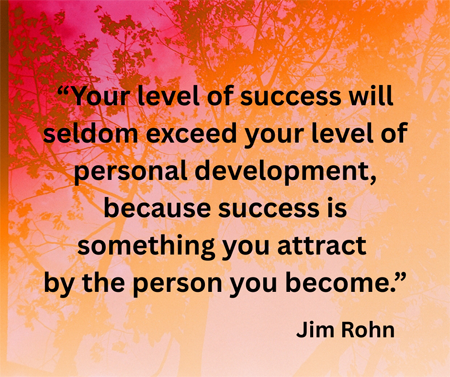
“Your level of success will seldom exceed your level of personal development, because success is something you attract by the person you become.” Jim Rohn

Chasing success in any situation, personal or professional, can burn you out. Your emotional well runs dry, and you’re running your life, career or business on fumes. Instead of focusing so much on the outer circumstances, focus more on your personal growth and inner development. This is where your success truly originates.

Instead of pursuing outer achievement, seek to become your best self. This could include improving your attitudes, letting go of self-limiting beliefs, as well as raising your self-confidence and self-worth. Continuing to uncover and release more of your tremendous inner potential will make you more appealing to others. And this results in more success for you.

Benefits of Personal Development

Cultivating personal development boosts your performance, strengthens your self-management skills, and increases your motivation. Most employers prefer an applicant with a positive attitude and eagerness to learn, over those with skills or a college degree. If employers are hiring employees for their optimism and enthusiasm, can you imagine how people in your personal and professional life would respond to these traits in you?

On a personal level, focusing on your self-growth lowers stress, adds to your wellbeing and supports authenticity. The Law of Attraction teaches that you attract what you think and who you are. When you work to enrich yourself on the inner level, you become the person others are looking for to socialize and work with. You open the door for the right people, opportunities and success to walk into your life.

By creating the mindsets, habits and ongoing dedication to self-improvement, you’ll radiate goodwill to those you meet and generate an aura of success. You’ll feel more comfortable in your own skin.  People, and success, will be attracted to the person you are and will become. 

Affirmation:

I am becoming the person the Universe wanted me to be. As I develop my inner self, letting go of old limiting beliefs, I open myself to greater good in all areas of my life. It’s safe for me to uncover my inner potential and let myself shine. The world responds well to my sense of goodwill as I radiate it to all those around me.

Watch the accompanying video, Personal Development Tools for Success.

As a focus mentor, hypnotherapist, and writer, Linda-Ann Stewart motivates women entrepreneurs and small business owners to focus and transform their business through deliberate actions that break through distraction and overwhelm to greater success, wellbeing and prosperity.To boost productivity and reduce overwhelm, register for her FREE guide, Design Your Best Day, at https://www.Linda-AnnStewart.com/guide.html

Heal From The Inside Out

Heal From The Inside Out

by Linda-Ann Stewart

Have you ever had an issue in your life that just wouldn’t go away? It might be weight, abundance, health or some other problem that just wouldn’t improve no matter how hard you focused on it? Most of us try to change our lives by working on the issue itself. “Okay, I have a weight problem. I’ll just diet and exercise.” Except the weight generally doesn’t stay off.

The problem is that you’re trying to heal the issue only in the physical, material world. But the issue is simply an outpicturing of an idea you’re holding in your mind. Your idea may have been formed as a child, and you’ve lived with it so long that it’s become an unconscious habit.

There Are Many Inner Reasons

There are many things that could contribute to the inner issue. It could be a belief concerning you and the challenge. For instance, you might have an unconscious limit to your income. Or you could be hanging onto an image of yourself with a specific problem. Many people who have been overweight most of their lives have a hard time adjusting to being slender after they’ve released the excess pounds. They may still have a self-image of being overweight, and that has to change before the weight reduction can be permanent.

You could have a belief that you’re not worthy of anything better, and that influences any attempt to create a better life. It causes you to hold yourself back or sabotage your progress. All of these concepts, and many more, could simply be outdated habits of belief that have operated below your mental radar to keep you from the life you deserve.

Dealing with the Outer Problem

Trying to deal with problems in the physical world alone, by moving from one fix to another, will only perpetuate the problem. There’s an old adage that says, “Those who don’t learn from their history are doomed to repeat it.” Twelve-Step Recovery programs know this, and advise members to heal their wounds before getting into a new relationship.

A friend of mine left one boss who didn’t appreciate her for another job where she thought she would be valued. Her new employer initially did so, but soon began treating her even worse than her original boss had. Since my friend hadn’t dealt with the underlying problem within her, it quickly returned.

Sometimes it’s necessary to take initial action in the material world to affirm your worth and get out of an abusive situation. A battered spouse should leave the toxic environment. An employee who’s being taken advantage of should find another position or learn to stand up for themself. But unless you want to keep re-creating the problem, you need to resolve its inner cause.

How to Deal with the Inner Cause

There are many ways to begin to heal the inner wounds. Assess what image you may be holding about yourself, or about the issue, and change it to reflect your desired future. Examine your attitudes about the change you want. Write down everything you think and say about your goal. Journal about it, asking what could be blocking you. (For more information on journaling, read my article Your Write To Self-Discovery) Use affirmations, self-hypnosis, or some other modality to release outdated beliefs.

Before there can be any permanent change, you have to resolve what caused the issue in the first place. It must be healed within before it will be healed in the outer realm. The problem isn’t what’s going on in your world, it’s what’s going on in your mind. Like ripples in a pond, once you heal the cause, the change will be expand into the outer plane of your life.

Affirmation:

I know that healing my inner issue will change the outer expression of it. The Universe completely supports my desire to improve my life. Anything I need to know about the original cause of my problem is now revealed to me. I recognize that it’s an outdated belief, and now change it to reflect what I want in my life. All levels of my mind accept and approve of the changes I desire.

As a focus mentor, hypnotherapist, and writer, Linda-Ann Stewart motivates women entrepreneurs and small business owners to focus and transform their business through deliberate actions that break through distraction and overwhelm to greater success, wellbeing and prosperity.To boost productivity and reduce overwhelm, register for her FREE guide, Design Your Best Day, at https://www.Linda-AnnStewart.com/guide.html

Overcome the Self-Talk Paradox

Overcome the Self-Talk Paradox

Many people have trouble using positive self-talk or affirmations, because they feel that they’re lying to themselves. They’re missing the point of what self-talk or affirmations seek to accomplish. This is the paradox concerning self-talk. When you state one idea that you immediately deny, you undermine your statement. By understanding the point of self-talk, and a tip to use it more effectively, you can overcome this contradiction, and be successful at transforming your life. Watch Overcome the Self-Talk Paradox.

Transcript:

Welcome. Some people have a problem with using self-talk, as they believe they’re lying to themselves. Do you know what I mean? For them to be able to accept their statement, they think they need to have already achieved the object, or the goal, of their statement. But they’re missing the point of what self-talk seeks to accomplish. This is a sort of imposter syndrome, and I’d like to share a reason causing it, and one way to handle the challenge.

I’m Linda-Ann Stewart, a focus mentor, writer and hypnotherapist. These videos are dedicated to empower you to focus and align your heart with your vision so you can achieve your goals.

The purpose of self-talk is that it is directive. What that means is that it describes something you aspire to, that you want to be, have or achieve in your life. Self-talk gives your conscious, and subconscious mind, guidance as to what you are choosing for yourself. You haven’t gotten there yet, but this is something you are choosing.

If you’ve already accomplished the object of your statement, or your goal, then your self-talk is simply confirming what you presently have in your life, right? Because self-talk is aspirational, therefore you’re aspiring to something. Self-talk isn’t for something you’ve already achieved.

The way to handle the challenge of thinking that you’re lying to yourself, that reaction, is to realize it’s simply your subconscious mind bringing up old programming. Your subconscious is just trying to help you in an outdated way. Thank it for its concern, and then tell it you want it to support you in this new direction. Then repeat your self-talk declaration, with energy and determination. That will imprint your subconscious more powerfully with the transformation you want. With the direction you want to go.

Think about what that direction is, and create a self-talk statement that you can give to yourself consistently and persistently.

Thank you for watching. If you liked this video, please give it a thumbs up. And if you’d like to be notified when I release more videos on mindset, motivation and empowerment, please like my channel and click on the bell. As always, stay focused.

Please read the accompanying article, 4 Steps to Transforming Your Thoughts through Self-Talk.

Don’t Believe Everything You Tell Yourself

Don’t Believe Everything You Tell Yourself

Many of the things we tell ourselves aren’t accurate or true about us. But we still believe and act on them. They affect our lives. You have the power to change those ideas, but first you have to recognize them. Here are some questions to ask yourself to shift your perspective and create a new life. Watch Don’t Believe Everything You Tell Yourself.

Transcript:

Welcome. Today, I’d like to discuss self-talk and how it affects your life. And what you can do to improve the things you tell yourself so your life changes.

We tend to believe what we tell ourselves, good or bad, don’t we? And then we act on that belief, whether it’s true or not. The majority of what you believe about yourself was likely accepted when you were young and you don’t notice it much anymore. But it has the power to undermine you and affect your actions. Ask any athlete. What they tell themselves about their performance affects it. But how much of what you tell yourself is actually true?

I’m Linda-Ann Stewart, a focus mentor, writer and hypnotherapist. These videos are dedicated to empower you to focus and align your heart with your vision so you can achieve your goals.

In my hypnotherapy practice, I helped people change what they told themselves, and their behaviors began to change as well. When you were a child, were you told you were klutzy, and now you trip over your own feet? What if that was a comment that was made during a single event and you took it to heart?

Too many times, as children, we believe something that was said to us and then we make it a self-fulfilling prophecy. And it affects us for the rest of our lives.

This happens when we’re adults, as well. For instance, also as a hypnotherapist, I worked with many smokers who told themselves they couldn’t quit. Their subconscious accepted that as fact, and no matter what they tried, they never succeeded at quitting smoking. When they came to me, one of the first things we addressed was dismantling that false belief. Only then could they be successful at stopping smoking. What idea have you accepted as an adult that you want to change?

Don’t believe everything you tell yourself, because many times those thoughts and their subsequent beliefs are wrong. They were created a long time ago, and no longer apply. What if you changed the unproductive things you told yourself to something more uplifting and constructive? Your subconscious would begin to accept those statements as true, and adjust your beliefs and actions accordingly. What could that change in your life?

  • What thought or belief can you now assess in a new light, from a new perspective?
  • And how can you change it so that it supports the life you want?

Start today, and focus on one area of your life. Be deliberate in the way you talk to yourself, and watch how your life changes. Thank you for watching. If you liked this video, please give it a thumbs up. And if you’d like to be notified when I release more videos on mindset, motivation and empowerment, please like my channel and click on the bell. As always, stay focused.

Please read the accompanying article, 4 Steps to Transforming Your Thoughts through Self-Talk.

4 Steps to Transforming Your Thoughts through Self-Talk

4 Steps to Transforming Your Thoughts through Self-Talk

Linda-Ann Stewart

Your attitude determines your direction

Your thoughts become your beliefs.

Your beliefs trigger your feelings.

Your feelings create your attitudes.

Your attitudes promote your actions.

Your actions lead to success or frustration.

There is a direct line between your thoughts and how well you do in life. Unfortunately, most of the mental programming behind your thoughts is undermining and sabotaging your efforts. This is because between 65% and 80% of what you tell yourself is counterproductive. Your thoughts are habits, programmed in your past from other people.

Because you were too young to know better, you absorbed older authority’s ideas and assessments, and began acting as if they were true. Those opinions went directly into your subconscious mind. Over the years, you reinforced the negative programming as you repeated those beliefs to yourself. As a result, those detrimental thoughts being so familiar and reflexive went unnoticed.

You Can Direct Your Thoughts

When you do start to become aware of your old thoughts, you can change them into more supportive and productive ideas. Instead of letting your past concepts control you, you can direct your thoughts. You have the ability to transform what you tell yourself, so that your thoughts, beliefs, attitudes and behaviors support your goals and aspirations. You simply have to use the same process you’ve been using, but in a more constructive way. As you do, you give the Law of Attraction instructions of what you want.

But you first have to become aware of those thoughts. And that’s the hardest part. Those old ideas have been flying around under your mental radar for years. Once you identify what those beliefs are, then you can change them by deciding what you want to tell yourself. Instead of criticizing yourself, give yourself beneficial feedback that aligns with the vision for your life. The Universe completely supports you in whatever is for your Highest Good.

Steps to Transform Your Thoughts

First step – Awareness of the old thought.

You have to catch that old thought as it streams through the edges of your mind.

Begin to notice when you’re tense, upset, sad, depressed, overwhelmed, anxious, or angry when nothing in your environment is in upheaval. If nothing in your immediate situation seems to be causing those emotions, check what thoughts are running through your mind. Identify the one(s) that are promoting your distress. 

Second step – Assess that old thought.

Bring the old thought to the front of your mind and examine it. Ask yourself the following questions.

  • Is it accurate?
  • Who says it’s true? This could be some idea you accepted sometime earlier in life, without considering whether it was a fact.
  • How can you challenge that old thought? What are some facts that would neutralize it?

Third Step – Transform that old thought.

  • Shift to a new perspective with the following questions.
  • What other things can you tell yourself that would be more productive?
  • What do you aspire to in this area or circumstance?
  • Develop a statement that directs you to the new way you want to believe, feel or act.
  • Create an affirmation reflecting Universal wisdom about the situation. 

Fourth Step – Be consistent with the new thought.

To be successful with this method, you have to counteract the old thought with the new one whenever the old one surfaces.

  • Repeat your new statement over and over, whenever you think of it.
  • To give your new statement more power, repeat it out loud, in a forceful voice. If you’re alone, you can even shout it. The emotion will get the attention of your subconscious and it will respond more quickly.

The Power of Persistence

You may notice, as you begin to change, that the old idea may try to fight you. It may try to make you doubt yourself. That’s normal. The subconscious doesn’t like change. Just acknowledge the objection as an outdated concept, and continue repeating your new choice. Pretty soon, your subconscious will accept your direction and support it.

When you transform your thoughts, it also transforms your behaviors and decisions. You begin to take actions that lead to greater success and fulfillment in your life. Changing your thoughts really can change the course of your life.

Affirmation:

I become aware of the things I tell myself that are not helpful or constructive. Those thoughts were necessary when they were created, but they aren’t now. It’s safe for me to change those ideas, as my situation is completely different now. Everything I choose is already mine in Universal Mind. Old thoughts that undermined my health, harmony and happiness are vanishing. I’m claiming new thoughts and ideas that help me build the life I want. The Universe completely supports me in transforming my thoughts, as it wants the best for me.

Please watch the accompanying video, Don’t Believe Everything You Tell Yourself.

As a focus mentor, hypnotherapist, and writer, Linda-Ann Stewart motivates women entrepreneurs and small business owners to focus and transform their business through deliberate actions that break through distraction and overwhelm to greater success, wellbeing and prosperity.To boost productivity and reduce overwhelm, register for her FREE guide, Design Your Best Day, at https://www.Linda-AnnStewart.com/guide.html

Book Review-It’s All In Your Mind

Book Review-It’s All In Your Mind

It’s All In Your Mind: How a teen rewired her mind to radically change herself, her life and her family

By Lindy Lumbert

I’ve known the author of this book for decades, and read her book when she first published it years ago. I still have my copy nearby in my bookcase. I loved the book then, and also love this latest release. It was a treat to read it again after all these years.

This is a entertaining tale of a teenage girl who realizes she has much more control over her life than she thought possible. She learns how her beliefs and attitudes affect her world, and how she can change them. Her journey leads her from feeling helpless and hopeless through stages of understanding of how her thoughts affect her and those around her.

The lessons from this insightful book are valuable for all ages, from 10 to 100 years old. If you want a fun read on how to change your thoughts, which will then change your life, I recommend you grab a copy of this empowering book.

(The link isn’t an affiliate link)

~ Linda-Ann Stewart

You Are Your Authority

You Are Your Authority

by Linda-Ann Stewart

Chains breaking
vector silhouette of a girl with raised hands and broken chains

Years ago, I discovered that the critical people in my life, who loved to pick at me and tear me down, were just echoing the condemning voices in my head. I’d spent so much time distracted, defending myself against those outer critics, that I hadn’t addressed the real issue, how I felt about myself. I’d given the past, and the people in it, authority over me.

Most of us have disapproving judgements about ourselves that tell us that we’re not good enough. Maybe you have an inner critic that tells you that you can’t do anything right, that you “should” be perfect, or that making a mistake is worse than death. I know of people who can’t take a day off because they’d feel guilty. And others who refused to hire someone to paint their house because they felt they “ought” to do it. Your internal judge pounds you with its condemnations, both from within, using guilt, and outwardly by reflecting your inner feelings in how the people in your life treat you.

Life Reflects Your Inner Struggle

Many people who have rebelled against authority figures in the past tend to have problems now with bosses, police, the IRS, etc. They defy internalized critical messages from their childhood environment, and don’t accept responsibility for their actions. Therefore, the energy that they have resisted and disowned increases and echoes back to them from the world.

Whatever you feel victimized by will mirror in your life. Just as my environment had been reflecting back to me what was already in my consciousness. I had to change my attitude from defending myself to addressing the internal messages from a position of strength. As I took responsibility for my own well being, the critics began to fade out of my life. I’m not saying it was easy. It wasn’t. But once I convinced myself that no one had the right to put me down, including my internal critic, my life began to improve.

How to Counter Your Critical Judgements

When you listen to the critical things that you say to yourself, you can begin to deal with them. As with everything in the subconscious, they once had a reason and a purpose to protect you. Although they’ve been trying to help you, they’ve been doing it in a way that you have outgrown. Those messages were patterned on the authority figures in your childhood so that you could fit into the conditions at that time. But they are no longer necessary, and won’t realize it until you tell them so. Believe it or not, they’re waiting for you to assert your power over them and reclaim your authority.

If the old ideas are telling you that you don’t deserve good, or that you’re not worthy, realize that the Universe has much more authority than the people who implanted those beliefs in you. And the Infinite knows that you deserve all the good that Life has to offer. Spirit is stronger than any outdated attitude. A Divine truth is that the Universe wants you to accept and express the wholeness of your being.

You Have the Right to Be Free

You have the right to re-examine the standards by which you have lived your life. Those condemning internal messages have been trying to keep you living within the bounds of someone else’s values. With all the knowledge you now have, you can change the attitudes that no longer serve you. Using affirmations and Divine guidance, you can transform the outdated values into ones that are in alignment with love, harmony, joy, abundance, and all the good there is.

Affirmations I used during this period were, “I am the authority in my life” and “I own my authority.” I had to review all the standards I’d grown up with, reassess them and release the ones that no longer served me. When I began to do this, it was scary. The first few times that I stood up for myself, I felt the sky might fall. It didn’t. Instead, the Universe rushed in to support me and my world expanded. The same will be true for you.

Affirmation:

I know that the Universe supports me in the good that I desire. The only one that keeps my good from me is my own thoughts about it. I now release any old concepts that might have restricted my acceptance of all the good I desire. As I place my desire in my mind, knowing that I deserve it, then the All of the Universe rushes in to fulfill it in a perfect way.

As a focus mentor, hypnotherapist, and writer, Linda-Ann Stewart motivates women entrepreneurs and small business owners to focus and transform their business through deliberate actions that break through distraction and overwhelm to greater success, wellbeing and prosperity.To boost productivity and reduce overwhelm, register for her FREE guide, Design Your Best Day, at https://www.Linda-AnnStewart.com/guide.html

Affirmation for Positive Thoughts Results

Affirmation for Positive Thoughts Results

Question about affirmations

Question: If I say affirmation for positive thoughts 10 times in the morning and at night, will I see results within a week?

Answer: If you say affirmations to be more positive 10 times in the morning and evening for a week, you might see an improvement in a week. However, it would also depend if you’re also monitoring your thoughts during the day.

Affirmations or any such reprogramming techniques work when you’re also addressing the issue during the periods that you’re not saying the, for example: the rest of the day. They’re not magical incantations.

Any reprogramming technique needs the conscious mind to support it and work with it. During the day, when you find yourself in a negative frame of mind, find a way to turn it around to think more positively about the situation, and then say the affirmation to yourself. This reinforces and strengthens the intention of the affirmation.

If you say the affirmation 10 times morning and evening, and during the day consciously choose to think about things differently, as well as using your affirmation at those times, you’ll probably begin to see a slight improvement within a week. If you keep doing it, that improvement will be progressive.

And when you find yourself more positive, you should keep monitoring your thoughts and saying your affirmation occasionally during the day to remind yourself to keep moving in the proper direction.

~ Linda-Ann Stewart

What You Wish For Others, YOU May Get

What You Wish For Others, YOU May Get

by Linda-Ann Stewart

moon and stars

Have you ever wished that something bad would happen to someone who’d wronged you? Not just that they’d learn not to do it again, but they’d be hurt as badly as you were? It could be a partner cheating on you, a coworker undermining you, or even someone cutting you off on the road. It’s natural to have the impulse that they should pay. Even as you become more spiritual, it’s hard to stay positive and objective in these difficult situations. But there’s a practical reason to avoid descending to the level of wanting retaliation and staying there.

Whatever you wish for someone else, you’re also wishing for yourself, whether it’s positive or negative. A friend of mine would unconsciously hurt himself whenever he got angry. He’d accidentally slam his hand in a drawer, kick the desk, or fall over the trash can. His anger, a strong emotion, connected with the image of retribution he wanted for the person who’d harmed him. This deeply impressed his subconscious, which didn’t recognize that the picture was for someone else.

How the Subconscious Functions

All the subconscious knows is that there’s a lot of energy attached to an idea, and it performs its role to fulfill the mold you give it. If you dwell on the desire for revenge, and you think about it frequently, the subconscious will figure that’s what you want for yourself. It will make sure you get what it thinks you want. This same principle is true if you’re jealous or envious of someone and hope they fail.

If you have a fleeting desire for payback, but dismiss it fairly quickly and move on with your life, the subconscious won’t act on it. It’s only when a person consistently and constantly wishes for vengeance that the subconscious takes notice.

The subconscious uses whatever you’re focused on for its model. When your predominant thinking is concentrated on retribution, the subconscious thinks you want the condition you’re intent on in your own life. This is the underlying reason why forgiveness is emphasized so much in various spiritual systems.

The Meaning of Forgiveness

Forgiveness releases the hostility and bitterness that you have towards a person. That energy can then be directed into a more beneficial purpose. But even more basic than that, your subconscious is given a more constructive image to work with and fulfill. When you want the best for someone, you know that you’ve forgiven them. This doesn’t mean that you give them permission to hurt you again. You forgive the person, not the offense.

You can be angry at what someone has done, or be in conflict with them, but still have a feeling of goodwill towards them. If compassion isn’t possible, then maybe you can simply remind yourself that the offender will experience what they need to eventually learn their lesson. It’s not your job to be the instrument of justice the Universe.

Find a way to let go of the negative image, preferably turning it into a positive one. The next time someone cuts ahead of you in line, bless them and let it go. Because whatever condition you want for someone else, you’re also asking for yourself.

Affirmation:

If someone harms me, I acknowledge my feelings, but let go of any wish for revenge. The Universe will deal with them in the best way for their evolution. I take care of myself and my feelings, and learn what I need to do so that I am protected from it happening again. I now desire for others what I desire for myself. In so doing, I’m expanding my level of acceptance of good.

As a focus mentor, hypnotherapist, and writer, Linda-Ann Stewart motivates women entrepreneurs and small business owners to focus and transform their business through deliberate actions that break through distraction and overwhelm to greater success, wellbeing and prosperity.To boost productivity and reduce overwhelm, register for her FREE guide, Design Your Best Day, at https://www.Linda-AnnStewart.com/guide.html