Browsed by
Tag: affirmation

How to Improve Your Happiness Level

How to Improve Your Happiness Level

by Linda-Ann Stewart

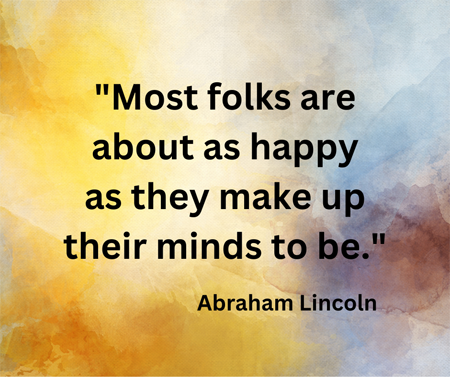
“Most folks are about as happy as they make up their minds to be.” Abraham Lincoln

Our western culture pushes the idea that achieving success will bring happiness, when the opposite is actually true. I’m sure you know people who pursue success, money and power, thinking it will bring them happiness. When it doesn’t bring lasting joy, they double down to accumulate more.

In actuality, the elation over a positive event, like a promotion or winning the lottery, is transitory. After a few months, the euphoria wears off, and the person’s level of happiness drops to what it was before the event.

Happiness could be defined as a state of wellbeing, contentment, satisfaction and fulfillment. These attributes depend on whether you have a generally positive mindset or not because happiness and optimism are closely intertwined.

The Good News about Happiness

According to some researchers, about 60% of your happiness comes from heredity and life situations beyond your control. Fear not, however. About 40% of your happiness derives from what you do in your everyday life. This means that much of your happiness is based on the choices you make. Building a well of happiness from within is under your control and more pervasive than seeking it from outside sources.

There are multiple benefits to happiness, beyond just making you feel good. Happiness affects the following and more:

Increases your success. You’re more likely to receive sales, promotions and awards.

Improves your health. Your immunity increases, heart disease decreases, and mental acuity is better as you age.

Opens up doors to greater creativity. When you’re in the flow, you have more mental resources to be inspired.

Causes you to be more productive. You have more energy and seek out more opportunities.

Enhances your relationships. You’re more open, interact better and little annoyances don’t bother you as much.

Builds a positive attitude. You look on the bright side of situations and seek out beneficial solutions.

Strengthens your ability to fulfill your potential. You tap into qualities that allow you to think better and make better decisions.

Raises your vibration. You feel lighter and clearer, therefore your vibration is higher.

Attracts more good to you. Allows you to be a clearer conduit for the Universe and the Law of Attraction.

All of these benefits are within your grasp, based on the choices you make each day. Happiness isn’t just a random occurrence, inspired by a positive experience. The thoughts you focus on develop new neurons and “neurons that fire together, wire together,” creating new connections in your brain. Through repetition of specific thoughts and actions, you can raise and strengthen your level of happiness and optimism.

How to Cultivate Happiness

By keeping your attention on something good, you cultivate new patterns of well being within yourself. And the more you do this, the more you feel good. It’s true that, in your brain, “What you focus on expands.”

Here are 6 ways to build more pathways in your brain to a sense of wellbeing, satisfaction and happiness:

Smile. Not only can a smile be contagious, it activates part of your brain to bring you more contentment. When you smile, your brain releases positive chemicals and hormones to make you feel good. Spend one minute in the morning to smile, and you’ll start the day off well.

Be kind. When you give to others, it also makes you feel good. Being kind activates parts of your brain that bring you a rush of euphoria. Just sending a card or email of appreciation to someone will brighten your day, as well as theirs.

Count Your Blessings. Gratitude stimulates the production of reward and pleasure chemicals in the brain, making you feel upbeat. Studies have found that if you list three things you’re grateful for each day, you’ll notice your happiness and attitude improve within three weeks.  

Detailed Gratitude. To deepen the impact of gratitude, each day find one thing that made you happy or grateful and write about it in detail. Spend at least a couple of minutes on this exercise. When you also visualize and savor the experience, this increases the effect and brings even greater satisfaction.

Meditate. Meditation grows the area of your brain responsible for joy. Whether it’s a consistent five minutes a day or longer, meditation will rewire your brain and your brain’s function. All you need to get started is to take long, slow deep breaths, in through your nose, and out through your mouth. Focus on your breathing. If your mind wanders (as it will), just bring it back to your breath.

Build social relationships. When you hang out with friends, this increases your ties with other people and improves your mental health. This can be done in person or virtually. I have several good friends who live a long distance from me, but we stay connected either through the phone or online.

Greater happiness can be yours using these small steps. Consistency will retrain your brain to be happier and build more neural circuits that support joy.

Affirmation:

The Universe wants the best for me. Success may not lead to happiness, but happiness leads to success. Happiness is a natural state for me, well within my grasp. I no longer wait to be happy but choose to be happy, now. What I focus on expands, and as I open myself to more happiness, more flows to me. The Universe supports me in finding simple ways to cultivate happiness in my life now.

Watch the accompanying videos, Craft a Sustainable Well of Happiness and A Fun Way to Cultivate Happiness.

As a focus mentor, hypnotherapist, and writer, Linda-Ann Stewart motivates women entrepreneurs and small business owners to focus and transform their business through deliberate actions that break through distraction and overwhelm to greater success, wellbeing and prosperity.To boost productivity and reduce overwhelm, register for her FREE guide, Design Your Best Day, at https://www.Linda-AnnStewart.com/guide.html You can contact her at LAS@Linda-AnnStewart.com or 928-600-0452.

Stop Worrying And Be Happy

Stop Worrying And Be Happy

by Linda-Ann Stewart

Stress and Overwhelm

When I was a child, my mother called me a “worrywart.” I was concerned about everything, from the well being of my friends, my parents dying (a normal childhood fear) to whether we were going to have a nuclear war (not normal for someone aged   seven). There was very little I could change about these situations, but that didn’t stop me from trying to figure out what I might do. Worry gave me the illusion of having some control over these circumstances.

From childhood, we’re taught to worry about our lives, the people around us, the state of the world. Mom would say, “Of course I’m worried about you, I care about you.” We then patterned ourselves on that model of caring. As children, if we worried about our grades, or about doing something wrong, then the adults considered that we were more mature. Our society perceives people who worry to be more earnest, responsible, or concerned about conditions. If we don’t show our apprehension about a serious situation, people sometimes perceive us as being flighty, a dreamer, not connected with reality, or worst of all (to them) – “an optimist.”

Worry Is Wasteful

But worry is a useless waste of energy. Most of what we worry about can’t be impacted by our being anxious about it. So far, we haven’t had a nuclear war, so I wasted all those hours reading the Civil Defense pamphlets on how to “duck and cover” and how to make a fallout shelter. Taking realistic actions (if there are any) to prepare for a future event is one thing, obsessing over it after we’ve done what we can or over what we can’t change is another. And because the subconscious follows the conscious mind’s lead, it figures if we’re worrying, we must want more to be apprehensive about.

When we worry, we’re simply living in fear. And FEAR stands for “False Evidence Appearing Real.” Fear of a possibility that may, but generally doesn’t, happen. If there is an outcome that is ordained (such as our getting older or inflation), nothing we can do will change it and we might as well enjoy each moment of life.

Mentally chewing a possibility over and over, and not allowing ourselves to have fun because maybe something bad might happen, is a waste of time and energy. Worry is immobilizing. It actually keeps us from being productive, efficient, and pro-active in the present. Universal energy is diverted to a cycle of anxiety instead of into being more creative and finding solutions.

The Habit of Worry

Worry can become a habit, and gives us an illusion of control over circumstances beyond our influence. We can only change our responses and ourselves. Some chronic worriers, in quiet times of happiness, will actually spoil it with an anxious thought of “What should I be worrying about?” I almost superstitiously felt that if I worried, the feared outcome wouldn’t materialize. Finally, I realized that I could more effectively use positive affirmations to bring out the best.

End the Cycle of Worry

The good news is that this habit can be broken. Remember what The Serenity Prayer teaches. “God grant me the serenity accept the things I cannot change, the courage to change the things I can, and the wisdom to know the difference.” The challenge is to “know the difference.”

Start writing down your concerns. This brings them into a more rational frame of mind, and you can assess their reality. Challenge them with the idea, “How likely is it that this will happen?” If it is a possibility, what’s the worst that can happen, and what would you do? Can you change the situation? If not, every time you begin to chew on it, remind yourself that you will deal with it if it happens. Find an affirmation that helps reinforce something positive happening.

I still occasionally find myself worrying about things, generally when I’m really stressed. But for the most part, I’ve broken the habit. In doing so, I’ve released more positive energy into my life. As the song says, “Don’t Worry, Be Happy.”

Affirmation:

Most of what I worry about never happens, so I end the wasteful cycle of worry. I recognize what I can change and what I can’t, and release those conditions beyond my control to the Infinite. Universal Mind guides me into making the best decisions about what I can change. Only good comes to me, as Divine Right Action takes place in every area of my life. I allow myself to enjoy happiness.

As a focus mentor, hypnotherapist, and writer, Linda-Ann Stewart motivates women entrepreneurs and small business owners to focus and transform their business through deliberate actions that break through distraction and overwhelm to greater success, wellbeing and prosperity.To boost productivity and reduce overwhelm, register for her FREE guide, Design Your Best Day, at https://www.Linda-AnnStewart.com/guide.html You can contact her at LAS@Linda-AnnStewart.com or 928-600-0452.

Don’t Take It Personally

Don’t Take It Personally

by Linda-Ann Stewart

My friend, Kay, is a waitress. Sometimes customers come in and are in a really bad mood. No matter how nice she is, no matter how good her service, no matter how delicious the food, they find something to complain about and leave a minuscule tip. If she didn’t know how good she was, when she discovered the skimpy gratuity, she might wonder what she did wrong. But because of her experience, she doesn’t take the customer’s attitude to heart. She recognizes that they were determined to be unhappy, and there was nothing she could do to change that. 

Many people don’t have Kay’s confidence. They’ll take someone else’s disposition personally. If a coworker is grumpy, this person may think that it’s their fault, even though the coworker crawled into the office that way. When I work with clients who are this sensitive, I remind them that they’re not responsible for the grump’s attitude. And the grouch would act that way no matter who they came in contact with.

The Problem Isn’t You

Even if someone deliberately attacks a person, the issue may not be about that specific person. The problem is the attacker’s own insecurities erupting, and simply wanting to destroy whatever good they see. It’s unfortunate, but misery loves company. If someone in pain sees another person with a better life, they’ll try to tear that more fortunate person down. People who are unhappy want everyone around them to feel as bad, or worse, than they feel.

It’s not that they’re evil. It’s just the only way they can have a little break in their pain. It gives them a brief distraction from it. Everyone is just trying to make themselves feel better, but we go about it differently. One person with a lot of anger, sadness and pain may try to spread it around so that others feel that way, too. While another person with sadness and pain will try to make others feel better because they don’t want anyone to hurt as they do.

In the movie, “You’ve Got Mail,” the chain bookstore owner (Tom Hank’s character) tells the small, independent bookstore owner (Meg Ryan’s character) that it’s not personal that he’s destroying her shop, it’s “just business.” It’s the same way with people who snap at you. It’s not personal; it’s just that they can’t handle their own emotions, so they dump them on others. They’d do it no matter who was there. Just as Tom Hank’s character would build a store without considering that another bookshop was in the area.

It’s About Them

Sometimes, people can get very personal in their attempts to make themselves feel better. I’ve had acquaintances who have told me that I didn’t deserve what I’d worked for, because I “hadn’t struggled enough.” Clients of mine have had friends blame them for walking away from the friendship, when it was the friend who did so. Other clients have had customers rage at them for not getting the work done three days before it was due. The attacks were irrational, but it’s hard to be objective and realize that when you’re being verbally assaulted.

When someone attacks you, puts you down, demeans you or belittles you, stand up for yourself. Because if you don’t, it’s unlikely anyone else will either. That doesn’t mean to counter-attack. If you know that what they’re asserting is false, say so, and walk away. It’s likely they’ll want to keep trying to get you to accept their belief, and won’t give up. Just know that it’s not true, and take back your power in this situation. Realize that it’s not about you or what you’ve done or haven’t done. It’s all about them and their pain. On the other hand, you don’t have to accept their degrading treatment of you simply because they’re hurting. Just address the situation with integrity and in the best way you can to support yourself. Remember that it’s not personal.

Affirmation:

I am a special, individualized expression of the Universe. I deserve to be respected and to respect myself. When someone attacks me, I recognize that it’s their issue, not mine. I remain objective, and don’t take it personally. I am Divinely guided as to the best way to respond to the situation to support myself. 

As a focus mentor, hypnotherapist, and writer, Linda-Ann Stewart motivates women entrepreneurs and small business owners to focus and transform their business through deliberate actions that break through distraction and overwhelm to greater success, wellbeing and prosperity.To boost productivity and reduce overwhelm, register for her FREE guide, Design Your Best Day, at Linda-AnnStewart.com/guide.html You can contact her at LAS@Linda-AnnStewart.com or 928-600-0452.

Can Kindness Backfire?

Can Kindness Backfire?

by Linda-Ann Stewart

No act of kindness, no matter how small, was ever wasted

I’m sure you’ve heard the saying, “No good deed goes unpunished.” This is often times true if you do your good deed for external gratitude or appreciation. If that’s the reason you perform your good deed, you miss the inner rewards that come with giving of yourself. But there are times in which too much kindness, or trying to push it on others, can be a problem.

The Downside of Kindness

There are times when your intention is to be kind, but it’s not helpful to the person, or may actually harm you. Here are some examples of when kindness can misfire.

Misinterpreting the situation. What you offer as a kindness the other person may reject. You may sincerely want to help those who want to remain self-reliant. For instance, a child whose parent tries to tie their shoe, only to have the child say, “I can do it myself.” In this case, respecting their independence is kindness.

People who don’t want help. You notice that someone needs help, but they don’t want any assistance. Early in my hypnotherapy and coaching practice, I learned that I couldn’t help those who didn’t want help. If I tried to convince them that things could be better, it caused them to rebel and cling more tightly to their issue.  Kindness would be to let go and wait until they ask for help.

Giving too much of yourself. Many years ago, I got into a situation where I was involved in a lot of groups. Because I was overinvolved and not taking care of myself, my health started to sputter and I was constantly sick. To be kind to myself, I had to back out of all of my commitments and lower my stress so I could get healthy again.

People expecting too much. This is the second part of the last example. The person in charge of one of the groups I was volunteered at insisted I continue to work, despite my health issues. She expected me to do what she wanted, no matter how it harmed me. When someone tries to bully you, your responsibility is to be considerate of your needs.

Find a Balance

Being kind is important, for your well being and for the benefit of others. But don’t try to force kindness on people, because that can create a backlash. And that may cause you to be less kind in the future. If you find yourself being taken advantage, of or trying to force kindness on others, take a step back and reassess.

When your kindness is rejected and you may want to shut down, remember your intention was to help. Aesop said, “No act of kindness, no matter how small, was ever wasted.” Find those who will welcome your help or those that you can help in smaller ways.

If you find yourself overextended, or being taken advantage of, pull back and set boundaries. Self-care must come first or you can’t help anyone else. The most important person to help and to be kind to is you.  Kindness spreads kindness, and when you attend to your needs, you have more to give.

Affirmation:

I am loving, compassionate, and kind to myself and others. I recognize when my kindness will be welcomed and accepted. Even in delicate or difficult situations, I am Divinely guided in ways to be kind with helping others. I treat others with respect and empathy. By embracing kindness, I’m able to wisely use it in the best way for everyone concerned.

Watch the accompanying video, Be as Kind to Yourself as You Are to Others.

As a focus mentor, hypnotherapist, and writer, Linda-Ann Stewart motivates women entrepreneurs and small business owners to focus and transform their business through deliberate actions that break through distraction and overwhelm to greater success, wellbeing and prosperity.To boost productivity and reduce overwhelm, register for her FREE guide, Design Your Best Day, at Linda-AnnStewart.com/guide.html You can contact her at LAS@Linda-AnnStewart.com or 928-600-0452.

Why Kindness Matters

Why Kindness Matters

by Linda-Ann Stewart

Hanging hearts

Kindness is a natural tendency that grows stronger when cultivated. Even toddlers instinctively help others. Altruism helps cultures to survive and thrive. When we cooperate, have compassion and empathy for each other, despite our differences, we can build and grow individually and as a group. Kindness binds society together.

How Kindness Affects You

Our brains were developed for us to be kind to each other. When you help someone, chemicals rush through your brain creating euphoria, empathy, connection, and well being.  Kindness also increases self-esteem, self-worth and optimism. It feels good to be considerate of others, and that encourages you to repeat the behavior. Practicing kindness rewires your brain to create more neural pathways for compassion and empathy.

Choosing to be kind is in your enlightened self-interest, as long as you’re doing it for others and not just for yourself.  Helping others lowers blood pressure, reduces stress and anxiety, and decreases risks for cardiovascular disease, among other benefits.  If you’re kind out of a sense of routine or obligation, you miss out on the advantages of someone who gives out of caring for others.  Kindness must be a sincere interest in others well being.

All major spiritual traditions consider kindness to be integral to their teachings. When you’re able to give of yourself, you’re at peace with yourself and your fellow humans. You open channels to allow more blessings to flow into your life. 

How Kindness Affects Others

You have no idea how a small act of kindness can impact someone. A smile, opening the door for someone, or a simple “thank you” can not only make a person’s day, but alter the course of their life. They may not remember you, but they’ll remember that you improved how they felt. Whether small acts or large, doing good for others creates change that goes far beyond what you’ll ever know.

Kindness spreads, like ripples in a pond. When you’re kind, with no expectation of reward, it inspires other people to follow your lead. They also become altruistic, and others pay it forward. Your impact multiplies as it affects even more people. If you want to make the world a better place, start with one good deed a day because that generosity will be contagious. Being kind is a gift to yourself, society and the world.  

Affirmation:

Kindness is an innate trait within me, and I now choose to practice it in all ways. I choose to be kind in my interactions with others. As I do good for others, expecting nothing in return, I uplift my spirit and the world around me. I am compassionate towards the people around me, knowing that they have their own trials to bear. Kindness is contagious, and others are inspired by my example. My life and the world at large is a better place due to my kindness and compassion.

As a focus mentor, hypnotherapist, and writer, Linda-Ann Stewart motivates women entrepreneurs and small business owners to focus and transform their business through deliberate actions that break through distraction and overwhelm to greater success, wellbeing and prosperity.To boost productivity and reduce overwhelm, register for her FREE guide, Design Your Best Day, at Linda-AnnStewart.com/guide.html You can contact her at LAS@Linda-AnnStewart.com or 928-600-0452.

Reprogram Your Negative Self-Chatter

Reprogram Your Negative Self-Chatter

by Linda-Ann Stewart

Thoughts in a head

Have you ever monitored what you say to yourself? Listened to the self-talk that chatters away without your being aware of it? Automatic phrases, such as “I can’t do this,” “I’m not worthy,” “I can’t handle this,” “I can’t afford it” and others. You may even find yourself saying them to the people in your life. These are beliefs that have been programmed into you, just like into a computer. Suppose the boss asks you to come into his office. Your first reaction may be “Uh, Oh. I’m in trouble,” even though he may want to praise you.

These ideas come from your past, but  they create a self-fulfilling feedback loop in your subconscious. Without your being aware of it, they provide background noise in your life. Is it any wonder that it’s hard to make any changes? They echo the words of parents, siblings, friends, teachers, anybody whose opinion you ever accepted, whether it was true or not. You were hypnotized into believing them, and you’ve stayed true to the conditioning.

How to Reprogram Negative Thoughts

An affirmation is a statement that confirms what you hold to be true, and though we generally use the term for positive declarations, these statements can be either positive or negative. When you tell yourself over and over that you’re not worthy , it convinces your subconscious that this is what you want, and your subconscious creates this reality.

The first step is to become aware of what you’re telling yourself. Write down these statements. Then formulate a sentence that counters what you’ve been believing all these years. Use it repetitively, because that’s how you were programmed in the first place. By hearing the same or similar things over and over.

Remain conscious of the background noise of your thoughts. And when the negative statement rises up, use your new phrase. Be patient. That original idea has been there a long time. It’ll take time, consistence, and persistence, but eventually you’ll change the thought to one that more truly reflects the Universe’s loving opinion of you.

Affirmation:

I monitor my self-talk and now become aware of what I’m telling myself. I realize that these negative ideas came from the past and have no relation to my present life. I recognize my own worth and the authority of my positive declarations. I am patient, consistent and persistent in reprogramming my mind, for I know that the changes are happening with every constructive affirmation that I state.

As a focus mentor, hypnotherapist, and writer, Linda-Ann Stewart motivates women to focus and transform their business through deliberate actions that break through distraction and overwhelm to greater success, freedom, wellbeing and prosperity. Register for her FREE Design Your Best Day guide and guided meditation video at www.Linda-AnnStewart.com/guide.html. You can contact her at LAS@Linda-AnnStewart.com or 928-600-0452.

Defuse the Power of Negative Thinking

Defuse the Power of Negative Thinking

by Linda-Ann Stewart

"We are what we think about all day long." Ralph Waldo Emerson

“We are what we think about all day long.” Ralph Waldo Emerson

What do you tend to think about all day? Is your awareness focused on beneficial, enriching thoughts or are you mainly thinking discouraging, undermining ideas and telling yourself that “I can’t?” The subconscious follows the tendency of your thoughts, and manifests the average of what you ponder during the day. If the overall quality of your thoughts is positive and uplifting, then the subconscious moves in that direction, and the converse is true.

It’s not easy to think positively every moment of every day. I’m not even sure it’s possible. But the subconscious doesn’t need you to be continuously constructive. It just needs you to be more positive than negative for it to create more harmony. But many people fear their negative thoughts, and that very fear gives those thoughts more energy.

Thought Is Creative

Each thought is potentially creative and is formed of energy. When a person recognizes they’ve considered a negative idea, many times they feel guilty for doing so, and become afraid that it will overcome any positive thoughts. Instead of simply switching their attention to something more beneficial, they continue to spiral downwards, and the negative thought takes on a life of its own. 

For instance, consider a baseball player who has missed every pitch in a game. Instead of figuring he just had a bad game, or the pitcher was especially good, he might begin to doubt his abilities. During practice, and the next game, he’ll tense up and worry too much about hitting the ball. He may recognize the tendency of his thinking, and try to overcome it. But now he’s fighting on two fronts. He’s concerned about not hitting the ball and fearful that his thinking is going to become a self-fulfilling prophecy. Once he begins to worry, and not trust his abilities, problems arise.

Your Subconscious Programs

Many times, the limiting, negative thoughts are simply a part of the subconscious trying to protect you and keep you safe. You might hear that little voice in your head saying:

  • If you don’t try, then you won’t fail, right?
  • By expecting the worst, you won’t be disappointed when it happens.
  • If you don’t succeed, then people won’t expect more of you.

This little voice is part of the subconscious mind using fear, doubt, and worry as a way to keep you from growing and moving forward. As long as you’re in familiar territory, then it figures nothing bad will happen.

It’s simply doing its job, repeating what it’s been programmed to do. So instead of vilifying it, resisting the negative thoughts and fearing their power, change your way of responding to them. When you become aware of a negative idea, simply say, “Thank you.” This immediately defuses the power you attach to the negative thought. You’re acknowledging its attempt to help, instead of rebelling against it. State, “Thank you, but that’s no longer helpful,” and respond with a beneficial concept.

How to Deal with Negative Thoughts

A long time ago, I learned a powerful way of dealing with negative thoughts. Divide a paper in half, write your affirmative goal on the left side, and record any objection that comes to mind on the right side, and then reply with “Thank you.” By writing down its concerns, and then acknowledging it with a “Thank you,” you’re letting the subconscious mind know that you recognize its distress. On the next line, write your goal again, and then any negative response, and “Thank you.” Continue until you don’t notice any negative thoughts about it coming into your mind.

Eventually, it will cease to bother you with protests, because you’ve let it know you’ve heard it, but are still going to move in that new direction. You’ve taken back your power. It will respect that, because that’s its true goal. As long as you accept your own authority in directing your life, the critical voice will quiet down. And you can now put your attention on what it is you want in your life, without wasting your energy resisting your negative thoughts.

Affirmation:

Negative thoughts are simply outdated ideas that I accepted sometime in the past. They are no longer valid or necessary to help me. Whenever I recognize myself dwelling on a negative concept, I remember that it’s simply my subconscious mind concerned about me. I respond with “Thank you, but it’s safe for me to experience progress.” I accept that I am the authority in my life and now take back my power.

As a focus mentor, hypnotherapist, and writer, Linda-Ann Stewart motivates women entrepreneurs and small business owners to focus and transform their business through deliberate actions that break through distraction and overwhelm to greater success, wellbeing and prosperity.To achieve your goals with confidence and ease in 4 powerful steps, register for her FREE training video and accompanying action planning guide at www.Linda-AnnStewart.com/setyourcourse.html. You can contact her at LAS@Linda-AnnStewart.com or 928-600-0452.

What Are You Training For?

What Are You Training For?

by Linda-Ann Stewart

woman with balloon

There’s an old saying that “You get out of a project what you put into it.” This means that however much energy you put into an activity, project or talent, you reap the benefits in equal measure. Athletes wouldn’t dream of attempting to “go for the gold” without training mentally and physically. An artist knows that their talent grows the more they exercise it. They recognize there will be hurdles to overcome, but those obstacles simply make their abilities stronger. 

The same is true of every aspect of life. If you focus your energy in the direction of prosperity, you’ll reap abundance. However, if you expend your thoughts in the area of fear of not being able to pay the bills, that’s what you’ll manifest. It’s like a bank account. Think of what thoughts you’re depositing in your mind. Whether those thoughts are positive or negative, you’ll earn interest based on the contents of you “account.”

It takes concentrated practice to be aware of what thoughts you’re thinking. And it takes even more attention and discipline to transform those ideas into ones that are positive and beneficial. Are you putting in ten thoughts of fear for every single thought of faith and confidence? If so, you’ll draw out whatever it is that you fear. When you practice focusing on the good each day, you’re exercising your confidence in the Universe. If you come up against an obstacle, you’ll have the strength to handle it. 

Whatever kind of energy you’re putting out, you’ll be experiencing that in your life. Are you depositing thoughts of an expanded, more abundant life? If not, begin to become aware of what kind of thoughts you’re depositing in your emotional bank, and start to train for a better life.

Affirmation:

I become aware of the thoughts that I think that might not be in harmony with the Universe. I train myself to transform them into the kind of idea deposits that I desire. I know that my thoughts manifest their equivalent in my life. I keep my thoughts positive and focused on the Universal Good. Even though I might not see the good in any situation, it is there awaiting my recognition of it. The more I practice this, the stronger and more empowered I become.

Seek Persistence, Not Perfection

Seek Persistence, Not Perfection

by Linda-Ann Stewart

“Nothing in the world can take the place of persistence.” Calvin Coolidge

“Nothing in the world can take the place of persistence.” Calvin Coolidge

There’s an old saying, “Anything worth doing is worth doing well.” But that concept puts so much pressure on people. They figure that if they can’t do it perfectly, it’s not worth doing at all. So, because they’re afraid of failing, or of doing less than their best, they procrastinate, or they get paralyzed and do nothing.

But perfection is not only overrated, it’s impossible. When you seek perfection, you don’t try anything new, because you’re unsure of the results. Or if you do try something new, it’s only what you know you’ll do well. You don’t do anything new or challenging that will allow you to grow or develop. But you don’t build proficiency in a vacuum. It takes time to develop the skill and knowledge to be able to excel at something.

Perfectionism Affects Your Mental Health

Seeking perfection is detrimental to your mental health, as it creates stress and anxiety. The pursuit of perfection also results in low self-esteem and depression. Your self-talk becomes abusive, as you berate yourself for always falling short of an impossible standard. Perfectionism promotes the opposite of what you seek, which is wellbeing and success.  

The obsession with perfection is prompted by the fear of failure and disapproval. You’re trying to live up to some unrealistic expectations, generally from childhood, and fear rejection if you don’t succeed. So by staying in your comfort zone and don’t try anything new, you can’t fail or be criticized. This causes you to avoid challenges, risk, growth and innovation.

Developing Persistence

My father used to say, “You don’t fail until you stop trying.” There’s a theory that leaders should seek failure, rather than success, because failing teaches you valuable lessons. You learn more about yourself, are able to cultivate creativity, and acquire empathy through failure. You discover what doesn’t work, and are able to apply that to your next attempt. Failure also fosters persistence. Each time you fail, you’re one step closer to success, if you keep trying.

Beginning meditators give up when they aren’t able to quiet their mind chatter. The point of meditation is the practice. The more you persist, the easier it will be to not give attention to the distracting thoughts that fly through your mind. Perseverance also gives the Law of Attraction a focus, letting it know that your idea is something you really want.

Instead of focusing on the outcome of perfection, focus on the process of what you’re trying to achieve. Practice doesn’t make perfect, but it does build expertise. Repetition forms muscle memory, and creates a habit. Training crafts mastery, which is as close to perfection as anyone can get. But you have to continue to practice, or else you begin to lose the skills.

Persistence Builds Character

Simply put one foot in front of the other and keep going. The journey of a thousand miles begins with the first step, but it continues with taking another step and another. Focus on what you accomplish each day. What did you learn? How can that lesson be put to use in moving forward? You’re more productive, efficient and effective, simply by continuing to take action.

Perseverance is necessary for a child to learn to walk, a writer to finish a book, or someone to change a habit. Giving up isn’t an option if you want to reach your goal. When you persist, despite obstacles, you build strength and resilience. This becomes a positive cycle that will bring you more success and self-confidence. Let go of the illusion of perfection, and embrace the power of persistence.

Affirmation:

I recognize that perfection is the province of the Universe, not the physical world that I live in. I let go of the need to live up to unrealistic expectations. Those ideas belong in the past. Now, I focus on my goal and take steps to bring it into reality. I learn from any setbacks, and apply that knowledge to my path as I commit myself to moving forward.

As a focus mentor, hypnotherapist, and writer, Linda-Ann Stewart motivates women entrepreneurs and small business owners to focus and transform their business through deliberate actions that break through distraction and overwhelm to greater success, wellbeing and prosperity.To achieve your goals with confidence and ease in 4 powerful steps, register for her FREE training video and accompanying action planning guide at www.Linda-AnnStewart.com/setyourcourse.html. You can contact her at LAS@Linda-AnnStewart.com or 928-600-0452.

Are You Shoulding on Yourself?

Are You Shoulding on Yourself?

by Linda-Ann Stewart

Your attitude determines your direction

My mom was an awesome life and spiritual coach. One of her main recommendations was to eliminate what she called the “must, ought, shoulds” in your life. When you use any of these three words against yourself, you increase your sense of shame, anxiety, pressure, and guilt.

Statements such as, “I should lose weight,” “I ought to be more productive,” or “I must exercise,” don’t inspire you to comply. These phrases are an attempt to force yourself to do what some inner part of you thinks is important. But coercion of that sort backfires because it’s human nature to rebel against that type of control.

Why You Resist

Often, to escape the negative feelings, you do exactly the opposite, or do something that gives you pleasure. But then, you feel even more guilt, which causes you to further avoid what your inner bully is trying to make you do. This just makes you feel worse. And around and around it goes.

The part of you that’s pushing you this way is doing it to try to help you. It doesn’t feel like support, but that inner voice is trying to get you to do something it thinks will be beneficial for you. That part just isn’t going about it very effectively. Instead of encouraging, it’s trying to pressure you.

How to Take Back Your Power

When you notice that automatic voice in your head, ask yourself these questions:

  • Why should I do what it wants me to do?  
  • What would change if I acted on what it wants?
  • What would the result or benefit be for me?
  • Is this something I want?

If the outcome is one you want, you can shift your response from resistance to making a deliberate choice to act. You can reframe “must,” “ought,” and “should” to “I choose to” or “I choose not to.” If you decide to take the action, that inner voice isn’t winning. Instead, by changing your attitude, you’re taking your power back.

Think about how you’ll feel afterwards by following through. For one thing, you’ll free yourself from that oppressive voice. And second, you’ll you receive the benefits of the action. And lastly, you’ll feel better about yourself and have more energy to do the things you love.

Affirmation:

I now let go of the “must, ought, shoulds” in my life. They aren’t serving a purpose for me anymore. I accept authority over my life. I’m guided by Divine Mind into my right thoughts and actions. The Universe supports, encourages and inspires me to make the choices that bring me the life I desire and deserve.

As a focus coach, hypnotherapist, and speaker, Linda-Ann Stewart motivates women entrepreneurs and small business owners to focus and transform their business through deliberate actions that break through distraction and overwhelm to greater success, wellbeing and prosperity.To achieve your goals with confidence and ease in 4 powerful steps, register for her FREE training video and accompanying action planning guide at www.Linda-AnnStewart.com/setyourcourse.html. You can contact her at LAS@Linda-AnnStewart.com or 928-600-0452.